
COLUMBA
of IONA
9 June • d. 597
“He who says he remains in him ought himself also to walk just like Christ walked.”
THE LIFE OF THE DOVE

Columba was born into the nobility in the north of Ireland, possibly in line to be the High King of Ireland. He was well known as an organiser, poet/song writer and prophet. He planted a great many monasteries in Ireland before being involved in a dispute over copyright while he was at the monastery in Clonard, under Finnian.
As part of his creative meditations, Columba copied out the book of Psalms from Finnian’s own handwritten copy. When Columba was due to leave, he wished to take his copy of the Psalms with him, but, as he had copied Finnian’s personal margin notes as well, Finnian was not happy for the book to leave Clonard. A legal battle followed, in which the High King of Ireland, Diarmait mac Cerbhiall, decided that Columba’s copy was to stay in Clonard. The dispute escalated into military battle and, as a result, when the battle was over, Columba was banished from Ireland. He vowed to convert as many souls to Christ as there were soldiers who had lost their lives in the copyright battle.
Columba sailed from the north coast of Ireland to the Irish-owned part of what we now call Scotland.38 He landed on other isles before settling on Iona, a place from which he could not see his beloved Ireland—knowing that if he lived on an isle where he could see Ireland, he would be too tempted to return.
On Iona, Columba founded what became his most famous monastery and mission centre. It was from here, around a generation after Columba died, that Aidan was sent to Lindisfarne and became the ‘apostle to the English’; many others, too, gained their training in Iona.
Columba was well known for going away for long periods of time to pray and converse with angels, and many of these encounters were witnessed by other monks on Iona, who saw the angels with Columba. On one occasion, when he shut himself in a hut for a length of time, blinding light could be seen through the cracks in the door and through the keyhole. His face is reported to have shone when he had been with God, just as the face of Moses did (Exodus 34:29–35).
Columba’s prophetic visions were famous… On one occasion, he sat writing in his hut on Iona when his countenance suddenly changed and he shouted, ‘Help! help!’ Two monks who were near the open door were alarmed and asked, ‘Why do you cry out?’
“I have directed the angel of the Lord, who was just now standing among you, to go quickly and help one of the monks who has fallen from the top of a roof in the Plain of the Oak Wood… How wonderful beyond words is the swift motion of an angel… Later, they learned that a man had indeed fallen from that great height, but he had broken no bones and did not even feel a bruise.”39
The Spirit of God was upon Columba greatly. He was a great prophet, teacher, leader and miracle worker, as well as being known for seeing God in creation.
38 Dál Riata… 39 Wentworth Huyshe, The Life of Saint Columba by Adamnan (1939), Book 3, ch. 15.
MEDITATION
Spend a few moments simply resting. Breathe gently and slowly. Become aware of the constant presence of God which envelops you and permeates you.
Columba’s prophetic ministry and angelic encounters came through his regular practice of withdrawing from the busy life of the monastery and mission work to engage in contemplative prayer.
How much time do you spend in contemplative prayer? This is not a speaking type of prayer (audibly or internally), but a dwelling in the divine presence, a resting with the beloved, a ‘prolonged immersion in the rivers of tranquillity which flow from God into the whole universe and draw all things back to God’.40
In what ways might you be able to deepen your times of stillness with God? How might it increase your ability to hear God’s voice and encounter angels?
Spend time with God now, dwelling upon these questions.
SCRIPTURE
“But whoever keeps his word, God’s love has most certainly been perfected in him. This is how we know that we are in him: he who says he remains in him ought himself also to walk just like [Christ] walked.”
— 1 JOHN 2:5–6
“But Jesus often withdrew to lonely places and prayed.”
— LUKE 5:16 (NIV)
BLESSING
May you, like Columba, seek to do good, even from the results of wrong.
May you be so drawn into the presence of God that your face shines from his presence.
May you be a great inspiration for others in their walk with God.
IN OUR OWN DAY
The Battle of the Books is one of history’s strangest origin stories for a great missionary movement. A dispute over a copied psalter and its marginalia escalated into deadly conflict. Columba’s exile became the seedbed of Christianity across Scotland and northern England. From the “wrong” came the sending of Aidan to Lindisfarne a generation later.
Today we live amid our own “copyright battles” — digital copying, AI training on books and art, ownership of words and songs. Columba reminds us that the Word of God cannot be chained. What began as a personal loss and national shame became the evangelisation of nations. God is still in the business of turning exile into mission.
TODAY’S FACTS • 2026
- Iona remains one of the world’s great “thin places”. Multiple organised pilgrimages sail to the island every summer, including major groups in June 2026 (Washington National Cathedral, Missional Wisdom Foundation, John Philip Newell, and others).
- The Iona Community (founded 1938 by George MacLeod) continues Columba’s legacy of prayer, peace and social justice from the restored Abbey.
- Modern seekers come precisely for what Columba modelled: withdrawal, contemplative stillness, and the sense that heaven and earth are very close.
Contemplation in an age of noise. Columba regularly withdrew “to lonely places”. Jesus did the same. In our always-on world, the invitation is the same: prolonged immersion in the rivers of tranquillity. Many who visit Iona today speak of the same angelic nearness and shining faces that the monks once witnessed.
Seeing God in creation. Columba was famous for it. In 2026, with ecological crisis and renewed interest in Celtic creation spirituality, this witness is urgently needed. The same island that once sent missionaries now draws people back to listen to the earth and the Spirit together.
TERMS & SYMBOLS OF THE AGE
When we speak of the world Columba entered, we often hear the words pagan, heathen and later Vikings. These are not simple labels of “bad religion.” They describe living spiritual landscapes that the Celtic saints both challenged and sometimes quietly baptised.
The indigenous Irish script was Ogham (᚛ᚑᚌᚐᚋ᚜), often called the Celtic tree alphabet or “runes of the Gael.” Each letter is a notch or stroke along a central stem-line, frequently carved on stone pillars or the edges of crosses. Columba’s Ireland and the Pictish north used such symbols alongside Latin learning. On high crosses and Pictish symbol stones one sees spirals (the journey of the soul), interlace (eternity and the interconnected web of creation), and animals (the wild creatures who also belong to God). Later, Norse runestones appeared in the Hebrides and on Iona itself after the Viking raids — the old stone language meeting the new. The “runes” were never mere decoration; they were prayers and memory made visible in stone.
See also the great high crosses of Iona and the Pictish stones of eastern Scotland for living examples of sacred Celtic symbol-language.
Columba’s own feast (9 June) stands only two weeks before the great summer feast of St John the Baptist (24 June — Midsummer / Alban Hefin in some Celtic calendars). In many Celtic lands the solstice fires of midsummer were not extinguished but re-lit in honour of the Forerunner who pointed to the true Light. Other turning points in the Celtic Christian year include:
- Imbolc / St Brigid (1 Feb) — the quickening of spring and the first lambs
- Beltane (1 May) — the great fire festival of purification and new life
- Lughnasadh / Lammas (1 Aug) — first fruits and the harvest begun
- Samhain / All Saints (1 Nov) — the thin veil between worlds
These feasts were not “pagan survivals” but the Church’s joyful claim that every season belongs to Christ.

Lift Your Voice with Columba
Also beloved on this feast: “The King of Love My Shepherd Is” (to the ancient Irish tune “St Columba”) and Benjamin Britten’s “A Hymn of St Columba”.
Feast Days of the Celtic Saints
From Celtic Saints: 40 days of Devotional Readings — David Cole (BRF 2020)
These dates mark the day each saint was “born into glory” — their earthly departure celebrated as heavenly arrival.
The book presents forty saints across the liturgical year. The dates above are the principal feast days featured.
A 40-Day Celtic Saints Pilgrimage
Beginning today, the Feast of Columba • One saint per day • Follow the spirit of David Cole’s devotional
9 JUNE — COLUMBA
Overchampionship Scorecard & Notes (editable)
Today I choose withdrawal over distraction. I will pray for 10+ minutes in silence.
Virtue Goal scored: _______________________________
Reflection: On this 40-day journey beginning with Columba, I notice…
One way I will withdraw like Columba and Jesus this week is…
A place or practice where I sense the “thin veil” between heaven and earth…

Further Reading & Pilgrimage
FOOTNOTES
- 38 Dál Riata (also Dalriada or Dalriata) was an Irish kingdom which included parts of western Scotland and north-eastern Ulster in Ireland. In the late sixth to early seventh century it encompassed roughly what is now Argyll and Lochaber in Scotland and County Antrim in Ulster. ↩
- 39 Wentworth Huyshe, The Life of Saint Columba by Adamnan (George Routledge & Sons, 1939), Book 3, ch. 15. ↩
- 40 Thomas Merton, New Seeds of Contemplation (Shambhala, 2003), p. 270. ↩
PAGAN
HEATHEN
VIKINGS
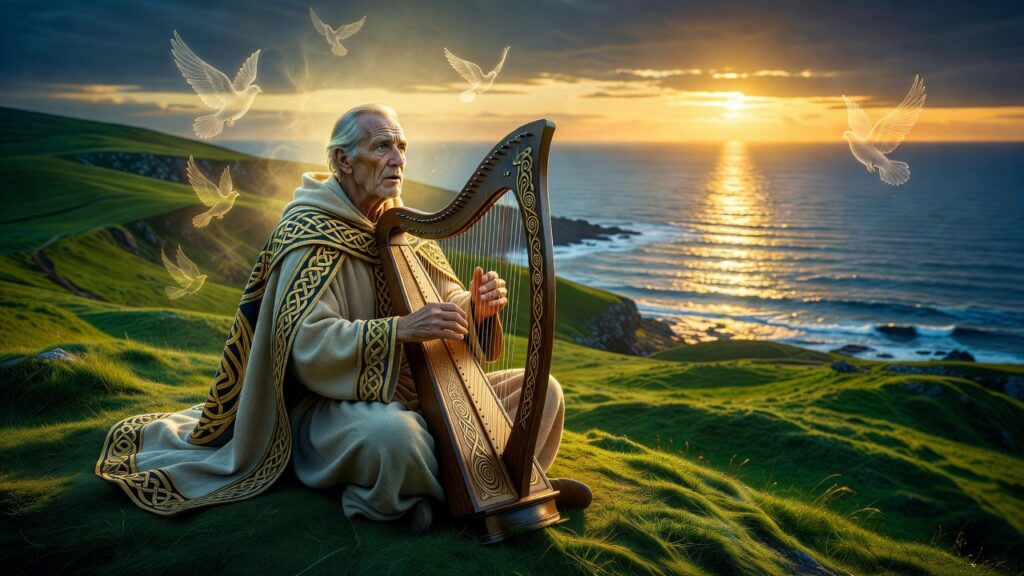
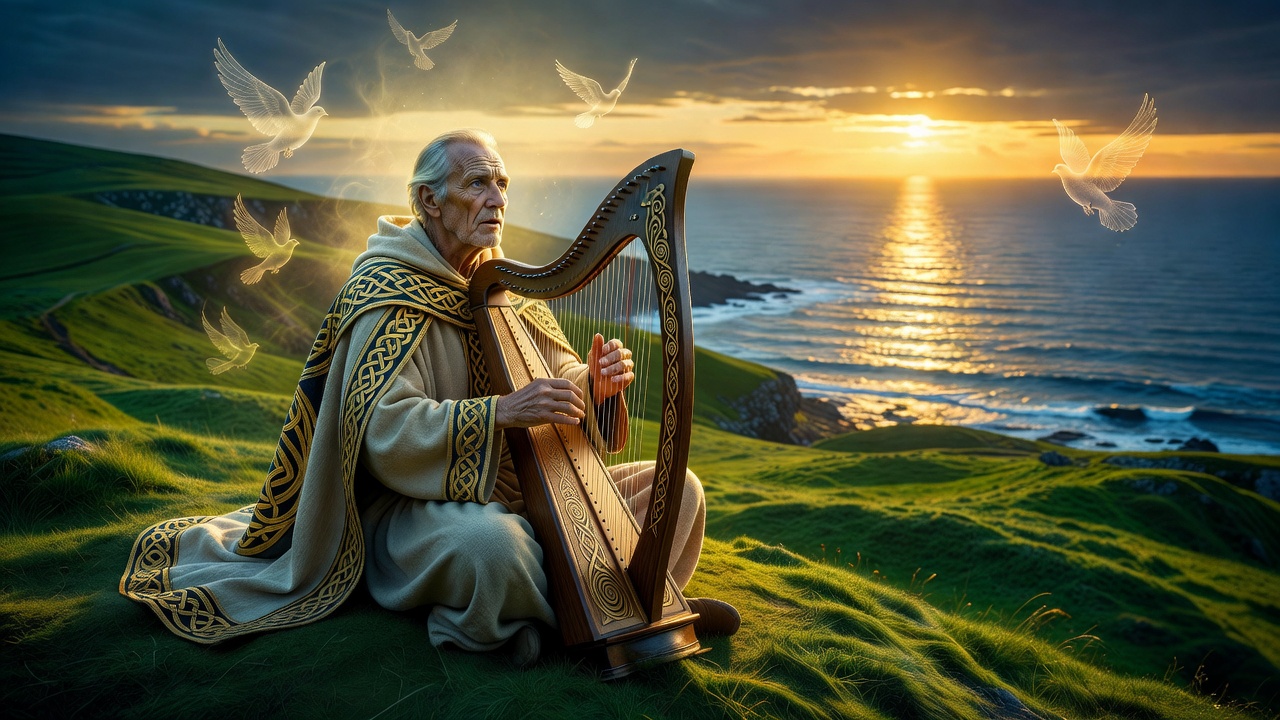
celtic bard, playing the HARP
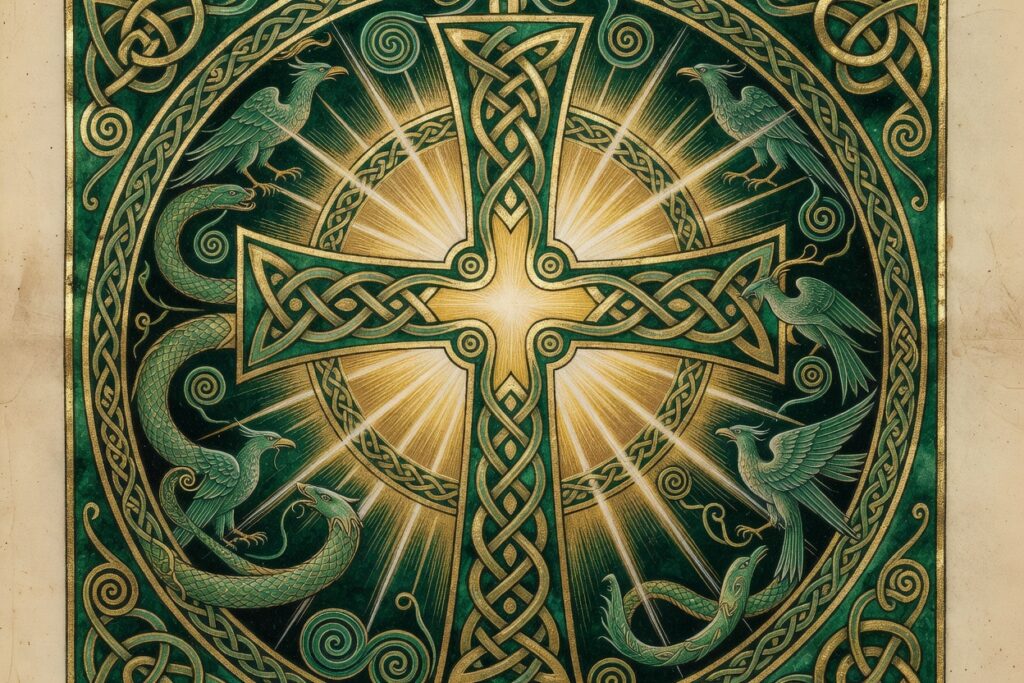
cleic cross knots
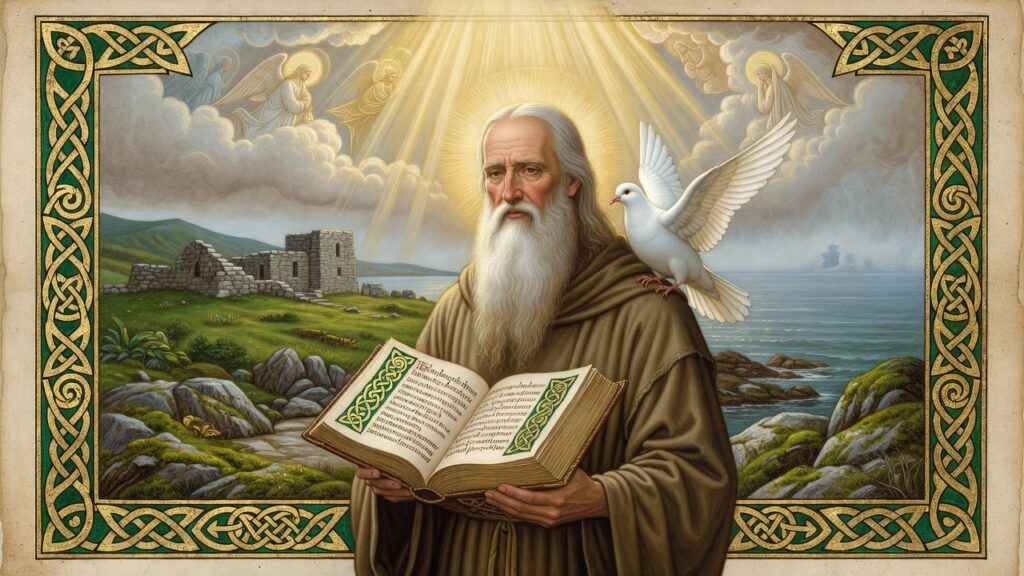
COLUMBAN prortait
Schreibe einen Kommentar
Du musst angemeldet sein, um einen Kommentar abzugeben.