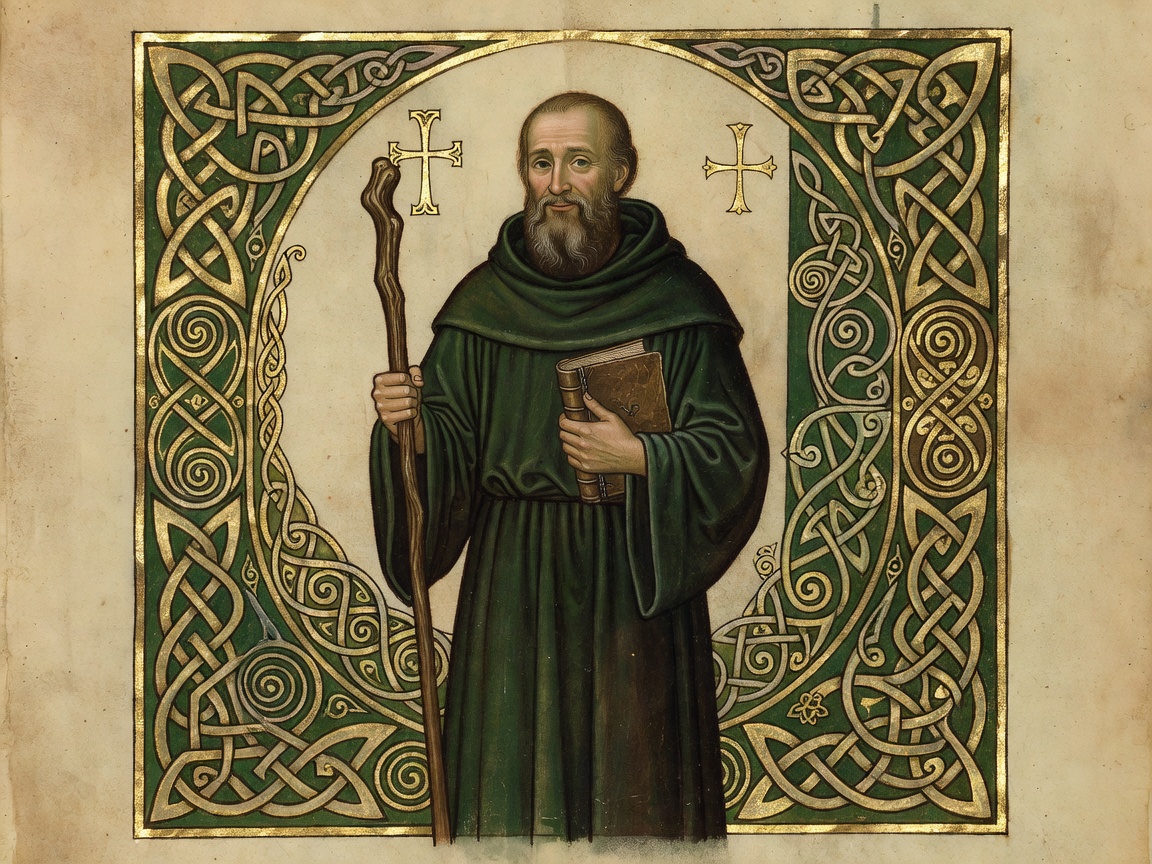

COLUMBA
of IONA
9 June • d. 597
“He who says he remains in him ought himself also to walk just like Christ walked.”
THE LIFE OF THE DOVE

Columba was born into the nobility in the north of Ireland, possibly in line to be the High King of Ireland. He was well known as an organiser, poet/song writer and prophet. He planted a great many monasteries in Ireland before being involved in a dispute over copyright while he was at the monastery in Clonard, under Finnian.
As part of his creative meditations, Columba copied out the book of Psalms from Finnian’s own handwritten copy. When Columba was due to leave, he wished to take his copy of the Psalms with him, but, as he had copied Finnian’s personal margin notes as well, Finnian was not happy for the book to leave Clonard. A legal battle followed, in which the High King of Ireland, Diarmait mac Cerbhiall, decided that Columba’s copy was to stay in Clonard. The dispute escalated into military battle and, as a result, when the battle was over, Columba was banished from Ireland. He vowed to convert as many souls to Christ as there were soldiers who had lost their lives in the copyright battle.
Columba sailed from the north coast of Ireland to the Irish-owned part of what we now call Scotland.38 He landed on other isles before settling on Iona, a place from which he could not see his beloved Ireland—knowing that if he lived on an isle where he could see Ireland, he would be too tempted to return.
On Iona, Columba founded what became his most famous monastery and mission centre. It was from here, around a generation after Columba died, that Aidan was sent to Lindisfarne and became the ‘apostle to the English’; many others, too, gained their training in Iona.
Columba was well known for going away for long periods of time to pray and converse with angels, and many of these encounters were witnessed by other monks on Iona, who saw the angels with Columba. On one occasion, when he shut himself in a hut for a length of time, blinding light could be seen through the cracks in the door and through the keyhole. His face is reported to have shone when he had been with God, just as the face of Moses did (Exodus 34:29–35).
Columba’s prophetic visions were famous… On one occasion, he sat writing in his hut on Iona when his countenance suddenly changed and he shouted, ‘Help! help!’ Two monks who were near the open door were alarmed and asked, ‘Why do you cry out?’
“I have directed the angel of the Lord, who was just now standing among you, to go quickly and help one of the monks who has fallen from the top of a roof in the Plain of the Oak Wood… How wonderful beyond words is the swift motion of an angel… Later, they learned that a man had indeed fallen from that great height, but he had broken no bones and did not even feel a bruise.”39
The Spirit of God was upon Columba greatly. He was a great prophet, teacher, leader and miracle worker, as well as being known for seeing God in creation.
38 Dál Riata… 39 Wentworth Huyshe, The Life of Saint Columba by Adamnan (1939), Book 3, ch. 15.
MEDITATION
Spend a few moments simply resting. Breathe gently and slowly. Become aware of the constant presence of God which envelops you and permeates you.
Columba’s prophetic ministry and angelic encounters came through his regular practice of withdrawing from the busy life of the monastery and mission work to engage in contemplative prayer.
How much time do you spend in contemplative prayer? This is not a speaking type of prayer (audibly or internally), but a dwelling in the divine presence, a resting with the beloved, a ‘prolonged immersion in the rivers of tranquillity which flow from God into the whole universe and draw all things back to God’.40
In what ways might you be able to deepen your times of stillness with God? How might it increase your ability to hear God’s voice and encounter angels?
Spend time with God now, dwelling upon these questions.
SCRIPTURE
“But whoever keeps his word, God’s love has most certainly been perfected in him. This is how we know that we are in him: he who says he remains in him ought himself also to walk just like [Christ] walked.”
— 1 JOHN 2:5–6
“But Jesus often withdrew to lonely places and prayed.”
— LUKE 5:16 (NIV)
BLESSING
May you, like Columba, seek to do good, even from the results of wrong.
May you be so drawn into the presence of God that your face shines from his presence.
May you be a great inspiration for others in their walk with God.
IN OUR OWN DAY
The Battle of the Books is one of history’s strangest origin stories for a great missionary movement. A dispute over a copied psalter and its marginalia escalated into deadly conflict. Columba’s exile became the seedbed of Christianity across Scotland and northern England. From the “wrong” came the sending of Aidan to Lindisfarne a generation later.
Today we live amid our own “copyright battles” — digital copying, AI training on books and art, ownership of words and songs. Columba reminds us that the Word of God cannot be chained. What began as a personal loss and national shame became the evangelisation of nations. God is still in the business of turning exile into mission.
TODAY’S FACTS • 2026
- Iona remains one of the world’s great “thin places”. Multiple organised pilgrimages sail to the island every summer, including major groups in June 2026 (Washington National Cathedral, Missional Wisdom Foundation, John Philip Newell, and others).
- The Iona Community (founded 1938 by George MacLeod) continues Columba’s legacy of prayer, peace and social justice from the restored Abbey.
- Modern seekers come precisely for what Columba modelled: withdrawal, contemplative stillness, and the sense that heaven and earth are very close.
Contemplation in an age of noise. Columba regularly withdrew “to lonely places”. Jesus did the same. In our always-on world, the invitation is the same: prolonged immersion in the rivers of tranquillity. Many who visit Iona today speak of the same angelic nearness and shining faces that the monks once witnessed.
Seeing God in creation. Columba was famous for it. In 2026, with ecological crisis and renewed interest in Celtic creation spirituality, this witness is urgently needed. The same island that once sent missionaries now draws people back to listen to the earth and the Spirit together.
TERMS & SYMBOLS OF THE AGE
When we speak of the world Columba entered, we often hear the words pagan, heathen and later Vikings. These are not simple labels of “bad religion.” They describe living spiritual landscapes that the Celtic saints both challenged and sometimes quietly baptised.
The indigenous Irish script was Ogham (᚛ᚑᚌᚐᚋ᚜), often called the Celtic tree alphabet or “runes of the Gael.” Each letter is a notch or stroke along a central stem-line, frequently carved on stone pillars or the edges of crosses. Columba’s Ireland and the Pictish north used such symbols alongside Latin learning. On high crosses and Pictish symbol stones one sees spirals (the journey of the soul), interlace (eternity and the interconnected web of creation), and animals (the wild creatures who also belong to God). Later, Norse runestones appeared in the Hebrides and on Iona itself after the Viking raids — the old stone language meeting the new. The “runes” were never mere decoration; they were prayers and memory made visible in stone.
See also the great high crosses of Iona and the Pictish stones of eastern Scotland for living examples of sacred Celtic symbol-language.
Columba’s own feast (9 June) stands only two weeks before the great summer feast of St John the Baptist (24 June — Midsummer / Alban Hefin in some Celtic calendars). In many Celtic lands the solstice fires of midsummer were not extinguished but re-lit in honour of the Forerunner who pointed to the true Light. Other turning points in the Celtic Christian year include:
- Imbolc / St Brigid (1 Feb) — the quickening of spring and the first lambs
- Beltane (1 May) — the great fire festival of purification and new life
- Lughnasadh / Lammas (1 Aug) — first fruits and the harvest begun
- Samhain / All Saints (1 Nov) — the thin veil between worlds
These feasts were not “pagan survivals” but the Church’s joyful claim that every season belongs to Christ.

Lift Your Voice with Columba
Also beloved on this feast: “The King of Love My Shepherd Is” (to the ancient Irish tune “St Columba”) and Benjamin Britten’s “A Hymn of St Columba”.
Feast Days of the Celtic Saints
From Celtic Saints: 40 days of Devotional Readings — David Cole (BRF 2020)
These dates mark the day each saint was “born into glory” — their earthly departure celebrated as heavenly arrival.
The book presents forty saints across the liturgical year. The dates above are the principal feast days featured.
BOISIL — MENTOR AND SEER
We know very little about Boisil except that he was the prior of Melrose and a teacher and friend of Cuthbert… (full text as previously inserted).
ADAMNAN — COLUMBA’S BIOGRAPHER & ABBOT
Adamnan (or Adomnán) was the ninth abbot of Iona and the biographer of Columba. His Vita Sancti Columbae is the primary source for almost everything we know about the saint, written around 697–700, nearly a century after Columba’s death. As abbot, Adamnan continued the Columban tradition of learning, prayer, and mission. He is also known for the “Law of the Innocents” (Cáin Adomnáin), a pioneering piece of legislation protecting women, children, and clergy in times of war — an early expression of Christian social justice rooted in the value of every human life made in the image of God.
Adamnan’s Life is not a modern biography but a theological portrait. It is structured in three books: prophecies, miracles, and angelic visions. It shows Columba as a man filled with the Spirit, a friend of angels, a prophet, and a lover of the Word. The archaeology we explored earlier (the confirmed hut on Tòrr an Aba, the high crosses, the manuscript tradition) gives physical reality to the world Adamnan described.
For our Overchampionship: Adamnan shows us the power of faithful memory and storytelling. He took the time to gather the stories of his predecessor, to write them down beautifully, and to hand them on. In a world of fleeting digital noise, the slow work of remembering the saints and telling their stories is itself an act of resistance and victory. Who are the “Columbas” in your life whose stories you are called to remember and pass on?
Continuing the Acts 2:38 journey with Adamnan: The gift of the Holy Spirit is not only for personal salvation but for the building up of the community and the telling of the story. Adamnan received the Spirit through the tradition of Iona and used it to write a book that has nourished the Church for 1,300 years. The same Spirit that fell at Pentecost is the Spirit that enabled Adamnan to see the angelic and miraculous in the life of Columba — and to record it so that we, far off in time and place, could also believe.
BRENDAN THE NAVIGATOR


Brendan was born around 484 in Ireland and became abbot of Clonfert. He is best known for the medieval legend of his sea voyage, the Navigatio Sancti Brendani, in which he and a company of monks (traditionally fourteen) set out in a small leather boat (currach) to find the “Promised Land of the Saints”, an island paradise in the western ocean. The tale is filled with wonders: an island of sheep, the great whale Jasconius on whom they landed thinking it an island, a crystal pillar rising from the sea, an island of birds that sang the divine office, Judas on a rock, and many other marvels. It may reflect real Irish monastic explorations into the North Atlantic.
In this journey Brendan and his brothers lived by the gifts of the Spirit in the most practical and perilous of settings. They chanted the Psalms daily, kept the Word at the centre, discerned the signs of God’s providence in the wonders they met, exercised courage and faith to sail into the unknown, and served one another in the close quarters of the currach. These were not earned or planned; they were grace for the need of the hour.
WELCHE GEISTESGABEN WERDEN IN DER BIBEL ERWÄHNT?
Die Bibel erwähnt verschiedene Arten von Geistesgaben, die hauptsächlich in den paulinischen Briefen dokumentiert sind.
Die Neue Testament identifiziert unterschiedliche Gaben wie “Lehre” und “Ermahnung”, “Weisheit” und “Erkenntnis” sowie “Prophetie”1. Die umfassendste Auflistung dieser Gaben findet sich im 1. Korintherbrief, Kapitel 122. In der apostolischen Zeit waren besonders bedeutsam: Weisheit, Erkenntnis, Stärkung, Unterscheidung der Geister, Gemeindedienste und Sprachengabe3.
Theologisch verstanden sind Charismen aus Gottes Gnade gegebene Geschenke, die ihre Träger befähigen, anderen Menschen in bestimmten Situationen zu dienen4. Diese Gaben werden von Gott auf vielfältige Weise spontan gegeben—sie werden von Menschen weder verdient noch erworben, vom kirchlichen Amt nicht vorhergesehen und können durch Sakramente nicht erlangt werden3.
Ein wichtiger Aspekt ist, dass die Anzahl dieser Gaben so vielfältig ist wie die Bedürfnisse der Kirche, und die Aufzählungen in 1. Korinther 12, Epheser 4 und Römer 12 nicht als vollständig betrachtet werden können—manche Gaben sind dauerhaft (notwendig für die Leitung der Kirche), während andere zeitlich begrenzt waren und ein wundersames Element hatten2. Die Charismen sind nicht auf die Anfangszeit beschränkt, sondern werden der Kirche zu allen Zeiten unerwartet gegeben und müssen jeweils neu entdeckt und anerkannt werden3.
2 Merrill Frederick Unger u. a., in The new Unger’s Bible dictionary (Chicago: Moody Press, 1988).
3 Herbert Vorgrimler, „Charisma“, in Neues Theologisches Wörterbuch (Freiburg; Basel; Wien: Herder, 2008), 112–113.
4 Siegfried Großmann, Beschenkt mit den Gaben des Heiligen Geistes: Charismatisches Christsein entdecken (R.Brockhaus, 2019), 17.
WIE LÄSST SICH LUKAS 24,38-49 DAMIT VERBINDEN?
Die Verse 38–49 bilden eine Einheit, die zeigt, wie Jesus die anfängliche Verwirrung der Jünger in Glauben und Auftrag umwandelt. Jesus adressiert ihre Bestürzung direkt und fordert sie auf, seine durchbohrten Hände und Füße zu betrachten, um sich davon zu überzeugen, dass er leibhaftig und nicht nur ein Geist ist (Lk 24,36–49).
Das Entscheidende liegt in der Verbindung zwischen physischer Präsenz und geistlicher Erkenntnis. Das scheinbare Unglauben trotz Freude bedeutet nicht Hartnäckigkeit, sondern eher überwältigte Freude—die Jünger konnten kaum glauben, dass dies wirklich geschah1. Als Jesus dann um Nahrung bittet und vor ihren Augen Fisch isst (Lk 24,36–49), liefert er den endgültigen Beweis für die Realität seiner Auferstehung.
Doch damit endet Jesu Werk nicht. Jesus eröffnet ihnen dann die Zusammenhänge der alttestamentlichen Schriften—Gesetz, Propheten und Psalmen—und öffnet ihnen den Verstand, um die Schriften zu verstehen (Lk 24,36–49). Dies ist nicht bloße Bibelbelehrung, sondern die Grundlegung ihres zukünftigen Zeugnisdienstes. Der Auferstandene ist in neuer Weise anwesend und öffnet damit die Zeit seines irdischen Wirkens für ihre Fortsetzung in die Zukunft2.
Schließlich erhalten die Jünger ihren Auftrag: Sie sind Zeugen dieser Ereignisse, und Jesus verspricht ihnen die Kraft des Vaters, auf die sie in Jerusalem warten sollen (Lk 24,36–49). Die Verse 38–49 zeigen somit einen Bogen: von der Überwindung des Zweifels über die Schrifterkenntnis bis zur Bevollmächtigung zum Zeugendienst.
2 Jens Schröter, Jesus: Leben und Wirkung (München, Germany: C.H.Beck, 2020).
BRENDAN’S VOYAGE AND THE CHARISMS OF THE RISEN LORD
This theological reflection on the gifts of the Spirit and the Lucan commissioning speaks directly into the life and voyage of Brendan the Navigator. In the Navigatio a small monastic company lives for years in a fragile leather boat on the open Atlantic. They chant the Psalms daily—the very Scriptures that the risen Jesus opens in Luke 24. They need wisdom for leadership and navigation, knowledge of the signs of God in creation, faith and strengthening to face storms and the unknown, discernment of spirits amid the wonders (the whale that is not an island, the crystal pillar, the singing birds), and practical service to one another in the close quarters of the currach.
None of these gifts are earned by merit, foreseen by office, or obtained through sacrament. They are given spontaneously by grace for the need of the moment—exactly as the text describes. The enumerations in 1 Corinthians 12, Romans 12 and Ephesians 4 are never exhaustive; the church always requires newly given and newly recognised charisms.
The risen Christ in Luke 24 does for the frightened disciples precisely what Brendan’s brothers needed on the sea: He overcomes half-belief and overwhelmed joy with the proof of his real, physical body (hands, feet, eating fish before them). The voyage itself was relentlessly physical—the currach, the salt, the hunger, the real islands. Jesus opens the Scriptures (Law, Prophets and Psalms) and founds their future witness upon that opening. He declares them witnesses and promises “power from on high”—the Holy Spirit, fountain and giver of every charism.
Brendan’s journey is a lived enactment of the same pattern: from the security of the monastery into the “sea” of the unknown, sustained not by human strength but by the gifts the Spirit supplies, carrying the witness of the risen Christ to new shores. The physical reality of faith, the centrality of the opened Word, and the empowerment to be witnesses “to the ends of the earth” are the true coordinates of the voyage.
For our Overchampionship: The gifts are for the mission, to “sail” as witnesses in the world, like Brendan and the apostles, guided by the Spirit who opens the Scriptures and sends us with power from on high. In our own fragile vessels we navigate the same Atlantic of our time, trusting that exactly the charisms needed will be given—unexpected, unearned, and always sufficient for the church’s present need.
AIDAN — HUMILITY, EQUALITY AND THE MILK OF TEACHING


Aidan came from Iona to lead a mission to the kingdom of Northumbria after the failure of a previous mission. King Oswald had inherited the throne, but, having been sent to Iona as a child during the kingdom wars, he wanted his new people, the Angles of Northumbria, to gain a proper knowledge of Christianity. They had fallen away from the faith when the Christian King Edwin had been killed in 633. The monks who led the first mission went back to Iona reporting that the Angles were ‘intractable, obstinate, and uncivilised’. Aidan suggested that perhaps these monks had been too harsh on the Angles and that they needed ‘the milk of simpler teaching, as the apostle recommends, until little by little, as they grew strong on the food of God’s word, they were capable of receiving more elaborate instructions’.
At this suggestion, the gathering of monks agreed that Aidan should be consecrated as bishop and sent to Northumbria to see if his approach would work. Aidan therefore brought a small group of monks from Iona and established his monastic centre on Lindisfarne, the first Christian centre on that island.
Aidan walked the kingdom, sharing the gospel with those he met. He walked, rather than riding a horse, so that he could engage with the people without seeming to be above them, either physically or in status. He spent time in the slave markets, using money that had been given for the work in the monastery, to buy slaves. Once he had bought them, he would allow them to choose freedom or a place of learning in his monastery. Many chose the place of learning, and so began one of the first schools for the English (Angles) in history.
Aidan exhibited great spiritual power, mixed with a gentle love and humility. He performed wonderful miracles, including driving a great fire away from the gates of Bamburgh Castle, through prayer, when the pagan King Penda attacked. He showed great acts of humility and grace: for example, on one occasion when the king had commanded him to ride, he gave away the horse, with its royal trappings, to a beggar on the side of the road. He was also a man truly loved by others, even those who opposed his theology. Bede tells us that numerous monks and bishops from the church of Rome took council with Aidan, and that the difference between the two streams of church (Celtic and Roman), regarding the date of Easter, was tolerated while Aidan was alive ‘because they had clearly understood that although he could not keep Easter otherwise than according to the manner of those who sent him, he nevertheless laboured diligently to practise the works of faith, piety and love, which is the mark of all the saints’.
Bede described Aidan thus: “A man of outstanding gentleness, devotion and moderation who had a zeal for God … Such were his love of peace and charity, temperance and humility; his soul which triumphed over anger and greed and at the same time despised pride and vainglory … he made it his business to omit none of the commands of the evangelists, the apostles, and the prophets … and the best recommendation of his teaching to all was that he taught no other way of life than that which he himself practised.” He wasn’t so much someone who practised what he preached as someone who only preached what he practised.
Aidan was a pioneer with a great heart and an amazing strength of character. He shared the gospel with a foreign people (with King Oswald’s help in translating from Aidan’s Irish Gaelic to the language of the Angles). He was a man of ‘outstanding gentleness, devotion and moderation who had a zeal for God’.
RICHTER 16,16 — VORBEMERKUNG ZU GOTTES TREUE UND MENSCHLICHER SCHWÄCHE
Richter 16,16: „Und es geschah, als sie ihn täglich mit ihren Worten bedrängte und ihn ängstigte, da wurde seine Seele bis an den Tod geängstigt.“
Kapitel 16: Gott gebührt allein die Ehre. Sein Wirken und seine Treue sollen bezeugt werden. Aber daneben beleuchtet Gottes Wort immer wieder unsere menschliche Unart, Schwäche, Sünde und Schuld. Das wird besonders deutlich durch den Schluß der Simson-Geschichte. So sind wir Menschen! Der Führer im Volk wird nicht Herr über seine Sinne (V. 1ff.), ja, er wird gänzlich abhängig von einer Frau und fällt durch das Verraten seines Geheimnisses völlig in die Hand der Feinde. Wohl hat er in alledem das Beten noch nicht aufgegeben und verlernt (V. 28), wohl darf er noch einmal bezeugen, auf welcher Seite trotz allem Versagen die eigentliche Kraft liegt (V. 28b), aber das Gesamtbild bleibt für uns Menschen beschämend und demütigend. Auf dem dunklen Hintergrund dieses Bildes aber leuchtet die Treue Gottes auf, der auch solche Menschen wie Simson noch irgendwie in seine Pläne einschaltet und auch ein solches Volk wie Israel nicht völlig dem Verderben preisgibt. Durch all die Richtergeschichten soll uns das Doppelte vor die Augen gestellt werden: Wir Menschen müssen geradezu vor uns selbst erschrecken. Das Volk fällt immer wieder in die Untreue zurück, und auch die Richtergestalten selbst sind ohne Ausnahme mit vielen Fehlern behaftet. Wir Menschen dürfen aber auf die Treue Gottes bauen. Er hält das Volk in seiner Hand, und er baut auch durch solche Richter sein Reich. Es wird zugleich klar, daß all diese Richtergeschichten auch ein Hinweis auf die Doppelbotschaft von Gericht und Gnade im Neuen Testament und in Jesus Christus sind.
Die Bibel mit Erklärungen: Erklärungen, I, Brunnen Verlag, Giessen; Basel 2013, 16. Auflage, 337–338.
LOGOS MAX PRE-INSIGHT: TÄGLICH BEDRÄNGT — WIE SIMSON DIE KRAFT VERLIERT, AIDAN SIE BEWahrt
„Täglich bedrängte ihn mit ihren Worten und ängstigte seine Seele bis an den Tod“ (Ri 16,16) — das ist das Urbild der hartnäckigen, schleichenden Versuchung durch die Welt: Begierde (Delila), Schmeichelei, politischer Druck, tägliche Nachrichten und Forderungen, die selbst einen geweihten „Richter“ (Führer) zermürben, bis er das Geheimnis seiner Kraft verrät. Simson, der Nasiräer, war von Gott abgesondert; seine Kraft war nicht seine eigene, sondern lag im Gehorsam (das Haar als Zeichen der Hingabe). Er wird nicht Herr über seine Sinne, fällt durch eine Frau, verliert die Kraft, wird gefesselt und verspottet. Auch er betet noch (V. 28), bezeugt, dass die Kraft beim Herrn liegt — aber das Gesamtbild ist demütigend.
Genau hier leuchtet Gottes Treue: Er benutzt auch den gefallenen Simson noch zu einem letzten Befreiungsschlag. Die Richtergeschichten zeigen das doppelte Evangelium: Wir müssen vor uns selbst erschrecken (auch „Heilige“ und Führer sind voller Fehler); aber wir dürfen auf Gottes Treue bauen, der durch schwache Werkzeuge sein Reich baut und auf das Gericht und die Gnade in Christus hinweist.
Aidan ist der Gegenentwurf zum bedrängten Simson. Er „triumphierte über Zorn und Gier“, „verachtete Stolz und Ruhmsucht“, „liebte Frieden, Mäßigkeit und Demut“ (Beda). Er war nicht „bedrängt“ in die Kompromittierung; er verkörperte, was er lehrte. Die „Haare“ seiner Kraft — die Charismen (Weisheit, Erkenntnis, Stärkung, Unterscheidung, Dienst, die wir am Tag 5 bei Brendan bedacht haben) — blieben ihm erhalten, weil er in Demut und Gleichheit (Jak 2) blieb. Er ritt nicht über die Leute hinweg (weder physisch noch im Status), er kaufte Sklaven frei und gab ihnen Wahl (Freiheit oder Lernen), er trieb durch Gebet das Feuer von Bamburgh zurück. Er „lehrte keinen anderen Lebensweg, als den er selbst lebte“. Die Kraft (geistliche Macht + Milde) diente der Befreiung und Bildung der „harten“ Angeln — nicht der Selbstbefriedigung.
Der gleiche Geist, der Simson zum letzten Schlag befähigte, erfüllte Aidan mit Ausdauer und Wundern für eine dauerhafte Mission. In Christus, dem wahren Richter und Führer, der nie fiel, wird unsere Schwäche zur Möglichkeit der Gnade. Die Richtergeschichten sind also nicht nur Warnung, sondern Verheißung: Selbst wenn wir „bis an den Tod geängstigt“ werden, kann Gottes Treue durch uns wirken — wenn wir wie Aidan in Demut und Verkörperung bleiben.
SCHRIFT — JAKOBUS 2,1–9 (KEINE PARTEILICHKEIT)
Meine Brüder, haltet den Glauben an unseren Herrn Jesus Christus, den Herrn der Herrlichkeit, frei von Parteilichkeit. Denn wenn in eure Versammlung ein Mann mit goldenem Ring und in prächtiger Kleidung kommt, es kommt aber auch ein Armer in schmutziger Kleidung, und ihr seht auf den, der das prächtige Kleid trägt, und sagt: „Setz du dich hierher auf den guten Platz!“, und zu dem Armen sagt: „Du stell dich dorthin!“ oder: „Setz dich zu meinen Füßen!“, habt ihr nicht unter euch selbst unterschieden und seid Richter mit bösen Gedanken geworden? … Wenn ihr aber die Person anseht, begeht ihr Sünde und werdet von dem Gesetz als Übertreter überführt. … Wenn ihr aber das königliche Gesetz erfüllt nach der Schrift: „Du sollst deinen Nächsten lieben wie dich selbst“, so tut ihr wohl.
MEDITATION (nach David Cole)
Aidan war ein Mann, der bescheidene Anfänge hatte und trotz seines Aufstiegs demütig blieb. Er beeinflusste mächtige Herrscher und niedrige Sklaven; er sah alle Menschen als gleich vor Gott an und behandelte sie deshalb gleich, unabhängig von ihrem irdischen Status.
Wie behandelst du verschiedene Menschen? Unterscheidest du eine Person oder Personengruppe als besser oder würdiger? Wie könntest du besser darin werden, jeden gleich zu behandeln und demütig als eins mit Gott zu sehen?
Verbringe jetzt Zeit mit Gott und verweile bei diesen Fragen.
SEGEN
Mögest du die große geistliche Kraft verstehen, die in dir wohnt.
Mögest du jeden, dem du begegnest, gleich behandeln ohne Parteilichkeit.
Mögest du andere nur in Dingen unterweisen, die du selbst bereits verkörperst.
Historische Bedeutung: Aidan, Ire aus dem kolumbanischen Iona, wurde zu den „harten“ Angeln (Northumbria) gesandt, die frühere Mönche für „unbelehrbar“ hielten. Sein Erfolg lag in der Demut und der „Milch der einfacheren Lehre“ — Gleichheit statt Überheblichkeit, Gehen statt Reiten, praktische Erlösung (Sklaven → Bildung/Freiheit) statt bloßem Predigen. Lindisfarne wurde zum Leuchtfeuer und zur „Tochter Ionas“. Die Toleranz in sekundären Fragen (Osterdatum) bei Einigkeit im Glauben, in Frömmigkeit und Liebe blieb, solange Aidan lebte. Nach seinem Tod zerbrach sie beim Konzil von Whitby 664. Aidan zeigt: Mission über kulturelle Gräben gelingt durch Verkörperung, nicht durch Härte oder Status.
AKTUELLE BEDEUTUNG: IRLAND, UNRUHEN, DER „BEDRÄNGTE“ REGIERUNGSCHEF
Aidans Heimat Irland und die keltischen Länder (Schottland, das ehemalige Northumbria im heutigen Nordosten Englands/UK) erleben heute eine neue Art von „Unruhen“. Undokumentierte Massenmigration, gestützt von Regierungs- und EU-Politik, hat zu raschem demografischem Wandel, Wohnungsnot für Einheimische, Grooming-Skandalen (Casey-Audit 2025), Kirchenanschlägen und Brandstiftungen (OIDAC Europe) und dem Gefühl kultureller Verdrängung bei der weißen christlichen Urbevölkerung geführt — genau die Fakten, die die Karten im Abschnitt „The Battle Today“ zeigen.
Keir Starmer, ausgebildeter Rechtsanwalt und früherer Chefankläger („Richter“ im weitesten Sinn, Director of Public Prosecutions), ist heute ungeliebter Regierungschef. Er ist „täglich bedrängt“ von der Einwanderungskrise: Small-Boats im Ärmelkanal, Millionenkosten für Hotelunterbringung von Asylsuchenden, anhaltende Proteste und Unruhen (2024 Southport-Auslöser mit über 1.800 Festnahmen, 2025 weiter aufflammende anti-migrantische Demonstrationen und Gewalt trotz verschärfter Politik). Vorwürfe der Parteilichkeit („two-tier policing“ — härteres Vorgehen gegen einheimische Demonstranten, nachsichtiger bei anderen Gruppen) und das Gefühl, die Sorgen der „einfachen Leute“ (natives) würden zugunsten von Zuwanderern ignoriert. Wie Simson wird die Nation durch tägliche Worte (Medien, Politik, Zahlen) „bis an den Tod geängstigt“ und riskiert, das Geheimnis ihrer Kraft (sozialer Zusammenhalt, christliches Erbe, Vertrauen) zu verraten — während die „intractable, obstinate“ heute auf beiden Seiten stehen: die Ankommenden, die Integration brauchen, und die Einheimischen, die sich fremd im eigenen Land fühlen.
Aidan zeigt den Ausweg: Nicht Härte der ersten Mönche (die scheiterte), sondern die „Milch“ der Demut, Gleichheit und praktischen Liebe. Kein Reiten über die Leute hinweg, sondern Gehen mit ihnen. Keine Parteilichkeit (Jak 2), sondern gleiche Würde für König und Bettler, Sklave und Freier — heute: für einheimische Arbeiterfamilie und ankommenden Migranten.
KONKRETE LÖSUNGEN ANHAND DER ENZYKLIKA MAGNIFICA HUMANITAS (PAPST LEO XIV., 2026)
Magnifica Humanitas („Über die Bewahrung des Menschen im Zeitalter der Künstlichen Intelligenz“, 15. Mai 2026, zum 135. Jahrestag von Rerum novarum) entfaltet die Prinzipien der katholischen Soziallehre neu: die gleiche Würde jedes Menschen (Abbild der Dreifaltigkeit), Gemeinwohl, Subsidiarität, Solidarität, universale Bestimmung der Güter, soziale Gerechtigkeit und integrale menschliche Entwicklung. Migranten, Flüchtlinge und die Ärmsten sind der „Lackmustest“ für Gerechtigkeit: Wird sie von Angst oder vom Geist der Brüderlichkeit getrieben? Die Enzyklika fordert sichere legale Wege, würdevolle Aufnahme und echte Integration, zugleich das „Recht zu bleiben“ in der Heimat durch Bekämpfung der Ursachen. Sie warnt vor Wegwerf-Kultur und Strukturen, die Ungleichheit automatisch erzeugen. Die „verworfenen Steine“ (Arme, Migranten, Geringste) sollen Ecksteine eines gemeinsamen Hauses werden, in dem Liebe und Treue, Gerechtigkeit und Friede sich begegnen.
Mit Aidan verbunden ergeben sich konkrete Schritte für unsere Zeit:
- Gleiche Würde ohne Parteilichkeit (Jak 2 + MH): Politik und persönliches Verhalten müssen die unendliche Würde von Einheimischen (besonders der armen und kulturell verdrängten) und Zuwanderern gleich achten. Keine Strukturen, die automatisch die einen zugunsten der anderen ausschließen. „Lackmustest“: Wie behandeln wir die Schwächsten auf beiden Seiten?
- „Milch der einfacheren Lehre“ + integrale Entwicklung: Wie Aidan Sklaven nicht nur freikaufte, sondern ihnen Wahl zwischen Freiheit und Lernen gab, brauchen wir heute Bildung und Formation für alle Bedürftigen — Sprach-, Werte- und Berufsbildung, die zur echten Integration und Würde der Arbeit führt (MH: integrale menschliche Entwicklung, nicht nur materielle Versorgung).
- Humble Präsenz und Subsidiarität: Führer (auch ehemalige Rechtsanwälte und Regierungschefs) müssen „gehen“ unter den Leuten, nicht über sie hinwegreiten. Entscheidungen nah bei den Betroffenen (Kirchen, Gemeinden, lokale Initiativen als intermediäre Körperschaften); Ressourcen der „Klöster“ (Kirche, Zivilgesellschaft) direkt an die Ärmsten weitergeben.
- Bevorzugte Option für die Armen + praktische Erlösung: Wie Aidan Klostergelder für die Sklaven einsetzte, sollen Mittel (auch staatliche) priorisiert werden für Bildung, Arbeit und Befreiung der Geringsten — einheimische Familien in Wohnungsnot und Migranten gleichermaßen. Die verworfenen Steine (MH) werden Ecksteine.
- Geistliche Kraft + Gebet (Charismen + MH): Aidan trieb das Feuer von Bamburgh durch Gebet zurück. Die Gaben des Geistes (Tag 5) — Weisheit, Unterscheidung, Stärkung, Dienst — sind heute nötig zum Schutz vor zerstörerischen „Feuern“ (Unruhen, kultureller Erosion, Angst). Beten und handeln in Demut, nicht im Spektakel.
- Gemeinsames Haus bauen: Statt Angst oder naiver Offenheit: sichere Wege + Integration + Ursachenbekämpfung (MH 81) und gleichzeitig Schutz des Rechts der historischen Bewohner, in ihrer Heimat zu bleiben und zu gedeihen. Fraternität statt Wegwerf — ein Haus, in dem Liebe und Treue, Gerechtigkeit und Friede sich umarmen.
- Verkörperung („only preached what he practised“): Politische und kirchliche Führer müssen das leben, was sie fordern. Nur so behalten sie „Kraft“ (Vertrauen, Autorität). Parteilichkeit und Statusdenken (Simson-Falle) führen zum Verlust der Kraft.
Das ist die Überwindung der „täglichen Bedrängnis“: Nicht durch härtere Worte oder größere Mauern allein, sondern durch Demut, Gleichheit und die Milch der Lehre, die stark macht — genau wie Aidan es den Angeln gab und wie es die Enzyklika für unsere Zeit neu entfaltet.
For our Overchampionship: Aidan zeigt, dass wahre Stärke in Demut und Verkörperung liegt. Die Charismen (Brendan) werden nur fruchtbar, wenn wir wie er „nur predigen, was wir leben“. In den Unruhen unserer keltischen Länder und unter dem Druck auf Führer wie Starmer sind wir gerufen, „zu gehen“ unter den Leuten, keine Parteilichkeit zu zeigen, die Geringsten (einheimisch oder zugewandert) durch Bildung und Liebe zu befreien und so — mit der Kraft des Geistes — das Licht von Lindisfarne neu zu entzünden. Die Übermeisterschaft gewinnt nicht, wer sich täglich bedrängen lässt, bis er sein Geheimnis verrät, sondern wer in Demut und Treue bleibt, bis die verworfenen Steine Ecksteine eines gemeinsamen Hauses werden.
THE ENDURING LEGACY: SPIRITUAL & HANDCRAFTING SKILLS OF THE CELTIC SAINTS — OUTCOMES TODAY
The Irish and Celtic saints were not only spiritual giants; they were practical builders of civilization. Their monasteries were not retreats from the world but powerhouses that transformed it. The same hands that copied psalters and prayed the hours also cleared forests, plowed fields, forged tools, and taught the next generation.
Founding Monasteries
From Iona to Lindisfarne, Clonmacnoise to Glendalough, Bangor to Applecross — the saints founded self-sustaining communities that became the heart of early medieval Europe. These were not mere religious houses; they were towns, hospitals, schools, and economic hubs. Today their legacy lives in the revival of intentional communities, eco-villages, and new monastic movements that seek to live the Gospel in shared life, hospitality, and simplicity.
Building Streets & Infrastructure
The “Street of the Dead” on Iona, pilgrim paths across Ireland and Scotland, roads connecting monasteries — the saints literally built the infrastructure of travel and pilgrimage. Their handcrafting skills in stone, wood, and metal created the high crosses, oratories, and scriptorium tools that still inspire. Modern outcomes: renewed interest in pilgrimage routes (Camino, Iona paths), sustainable architecture, and community-led infrastructure projects rooted in beauty and purpose rather than profit.
Starting Agriculture & Trade
Monks cleared land, introduced new crops and livestock breeds, developed milling and brewing, and created trade networks that linked Ireland, Scotland, England, and the Continent. They turned “waste” places into gardens. Today we see this in the resurgence of regenerative farming, monastic gardens and breweries, fair-trade initiatives inspired by Celtic hospitality, and the theological conviction that caring for creation is part of the Gospel (echoing Columba’s seeing God in nature).
Literature & Education
The greatest handcrafting of all was the preservation and creation of books. Scriptoria copied the Scriptures and classical texts, illuminated them with the Logos in color and knot, and educated generations in Latin, Greek, theology, poetry, and science. Without the Celtic saints, much of Western learning would have been lost. Boisil’s final act — reading John with Cuthbert — was education as spiritual formation. Modern outcomes: the revival of classical Christian education, homeschooling and new monastic schools, the enduring power of beautiful books and illuminated art, and a counter-cultural emphasis on deep reading and formation over information.
For the Overchampionship:
The Celtic saints did not win by spectacle. They won by building slowly, teaching faithfully, farming sustainably, writing beautifully, and mentoring the next generation in the power of the Spirit. Their “victories” are still bearing fruit 1,400 years later. On this 40-day journey, ask: What am I building, planting, writing, or mentoring that will outlast the noise of the world’s championships?
The 40-Day Journey (Compact Menu)
Full detailed readings for each day are in the RTF plan and previous sections. This is a quick reference menu. Focus is on today’s saint (Aidan) and the interactive board for „which powers rule“.
THE BATTLE TODAY: MAPS OF STRUGGLE IN THE CELTIC LANDS
The light Columba and the saints brought is under siege. Undocumented mass migration, backed by EU policies and UK/Irish/Scottish governments, has led to rapid demographic replacement of native white Christian populations, grooming gang scandals targeting native girls, church attacks and arson, housing crises for natives, and cultural erosion. These maps illustrate the facts from official data and reports (ONS, police stats, Casey audit, OIDAC Europe, etc.). The overchampionship calls us to discern the powers and stand with the heritage of the saints.

UK: White British declining as % (from ~87% in 2001 to ~74% in 2021, projections lower); grooming gangs (Pakistani-heritage men disproportionately involved in Rotherham etc., per Casey 2025 audit); 9,648 crimes against churches 2022-2024; church arsons up.

Ireland: Housing crisis exacerbated by asylum seekers; violent protests and arson at centers (Coolock, Saggart 2024-2025); native Irish feeling displaced; government/EU policies driving inflows despite public opposition.

Scotland/UK overall: Net migration driving growth while native birth rates low; Scotland population pressures from low migration in some projections; cultural shifts in cities; rise in anti-Christian incidents across Europe (OIDAC 2025: 94 church arsons in 2024, up sharply).
Data sources: ONS UK population estimates 2024/2025, Casey National Audit on Grooming Gangs 2025, OIDAC Europe Report 2025 on anti-Christian hate crimes (2,211 incidents, 94 arsons), Irish government and protest reports, academic projections on demographic change. These are facts of policy-driven transformation, not conspiracy.
TAKE YOUR STAND: THE CHOICE IN THE OVERCHAMPIONSHIP
The maps and facts above show the struggle: mass undocumented migration, enabled by governments and the EU, is transforming the Celtic lands Columba and the saints evangelized. Native white Christian populations are being displaced in their own countries, churches attacked, girls groomed and raped by organized gangs with authorities slow to act due to political correctness, and cultural heritage eroded. The saints built a civilization of faith, learning, and order. What will you do?
Choose your position. Click a button to declare your stand (this is for your personal reflection in this editor file; no data is sent).
In the spirit of the overchampionship and the saints: The true victory is in standing for the light Columba brought, not the darkness of replacement and erasure. Log your stand in the notes above.
INTERACTIVE SIMULATION BOARD: WHICH POWERS RULE?
Relate the ancient maps (Dál Riata & the 1st-century Holy Land) to modern Iona. Select powers and entities, place their influence on the maps, then run the simulation to discern which forces truly rule across time — and how the Logos still governs the thin places.
POWER / ENTITY PALETTE — Click to select, then click a map to place influence
Selected: None — click an entity above


CURRENT PLACEMENTS (click to remove)
This board is a tool for the 40-day pilgrimage: discern the powers, then choose the way of the Dove.

Key Monasteries Founded by the Celtic Saints • Click for Maps & Anam Chara
The mother house. “Thin place” of angels and the Dove. Old Melrose (Boisil & Cuthbert)
Boisil’s home. Soul-friendship forged here. Anam Chara in action. Lindisfarne (Aidan, Cuthbert, Finan)
Apostle to the English. “Holy Island”. Glendalough (Kevin)
Valley of two lakes. Extreme hospitality & creation care. Clonmacnoise (Ciaran)
Great school on the Shannon. Literature & learning. ANAM CHARA — Soul Friend (Soul Mate)
Click for full explanation (Boisil & Cuthbert model)
These monasteries were powerhouses of spiritual life and handcraft: they built communities, farmed, traded, copied books, and educated Europe. Their legacy is still visible in the landscape and in today’s Celtic revival.
Iona — Founded by St Columba (563)

Location: Inner Hebrides, Scotland. “The Isle of Columba” (Ì Chaluim Chille).
Significance: Columba’s exile became the launchpad for the conversion of Scotland and northern England. Site of angelic encounters, the writing hut (now archaeologically confirmed), high crosses, and the “Street of the Dead.”
Legacy today: Restored abbey, Iona Community, world-famous pilgrimage destination and “thin place.”
Old Melrose — Home of Boisil & Cuthbert

Location: By the River Tweed, Scottish Borders (near modern Melrose).
Significance: Founded by St Aidan (c. 635). Boisil was prior, then abbot. Here he mentored Cuthbert as anam chara, prophesied his future, and spent his last seven days reading John’s Gospel with him.
Legacy: The site of profound soul-friendship and the transmission of the Spirit from one generation to the next. Later Cistercian abbey nearby.
Lindisfarne (Holy Island) — Aidan, Cuthbert, Finan

Location: Tidal island off Northumberland, England.
Significance: Founded by St Aidan (sent from Iona in 635) as base for the mission to the English. Home and bishopric of St Cuthbert and later St Finan. Famous for the Lindisfarne Gospels and the “apostle to the English.”
Legacy: Still a living pilgrimage site with a causeway that appears and disappears with the tides — a perfect image of the “thin place.”
Glendalough — Founded by St Kevin (6th c.)

Location: Glendalough (Valley of Two Lakes), County Wicklow, Ireland.
Significance: Kevin’s hermitage grew into a major monastic city. Famous for extreme hospitality (the blackbird legend), asceticism, and harmony with creation.
Legacy: One of Ireland’s most visited monastic sites, with round tower, churches, and a powerful sense of sacred wilderness still intact.
Clonmacnoise — Founded by St Ciaran (6th c.)

Location: On the River Shannon, County Offaly, Ireland.
Significance: “The University of the West.” Major center of learning, art (high crosses, crosses of the Scriptures), and pilgrimage. Ciaran died young; the community became one of the greatest in Europe.
Legacy: Extraordinary collection of high crosses, round tower, and cathedral ruins. Symbol of Celtic learning and the marriage of faith and culture.
ANAM CHARA — Soul Friend (Soul Mate in the Spirit)
Anam Chara (Irish: “soul friend” or “soul mate”) is one of the most beautiful and distinctive gifts of Celtic Christianity.
It is a deep, intentional spiritual friendship in which two people commit to walking together in the presence of God. The anam chara is:
- A companion for confession and healing (before the formal sacrament of penance was widespread).
- A mirror who sees your true self and calls you to it.
- A guide and prophet — someone who can speak hard truths in love.
- A fellow pilgrim who prays with and for you, shares the journey, and helps you discern the will of God.
Boisil was Cuthbert’s anam chara. He recognized the young man’s calling the moment he arrived at Melrose (“Behold, the servant of God”). He trained him, prophesied his future as bishop, and in his final days poured the Gospel of John into him day by day — not as information, but as formation in love.
“A person without an anam chara is like a body without a head.” — old Irish saying (paraphrased in Celtic tradition)
In our overchampionship journey, ask: Who is God giving me as anam chara? Am I willing to be one for someone else? This is how the Spirit multiplies — not through programs, but through faithful soul-friendship.
This page is a living editor. All sections (notes, scorecard, reflections) are directly editable in the browser. Save or print to keep your 40-day record.
FOOTNOTES
- 38 Dál Riata (also Dalriada or Dalriata) was an Irish kingdom which included parts of western Scotland and north-eastern Ulster in Ireland. In the late sixth to early seventh century it encompassed roughly what is now Argyll and Lochaber in Scotland and County Antrim in Ulster. ↩
- 39 Wentworth Huyshe, The Life of Saint Columba by Adamnan (George Routledge & Sons, 1939), Book 3, ch. 15. ↩
- 40 Thomas Merton, New Seeds of Contemplation (Shambhala, 2003), p. 270. ↩