St. Patrick
Day 27 • 7 July 2026 • Downpatrick • Lampedusa • Battle for Christendom
Patricius — slave on Irish hills • 100+ prayers day and night • boat in the vision • Easter fire at Tara • snakes and druids
The Life of St. Patrick
| Detail | Tradition |
|---|---|
| Birthplace | North-west Britain, Rheged — Christian noble family |
| Youth | Wild; not yet deeply Christian |
| Age 16 | Kidnapped by Irish pirates; sold as slave |
| Slave work | Herding animals on Irish hills — deep prayer life began |
| Death | c. 461 • Feast: 17 March |
Patrick probably grew up on the north-west coast of Britain, in an area known as Rheged. He was from a Christian family of noble birth, but was a wild youth. At 16 he was kidnapped by pirate raiders from Ireland and taken back and sold there as a slave. Patrick, although he was not a Christian himself at this point, later recalled that his kidnapping was ‘because [he] departed from God, and kept not his precepts, and [was] not obedient to the priests who admonished us for our salvation’.1 His work as a slave was to care for animals on the Irish hills. There he found his own relationship with God, which grew deep indeed and included many mystical encounters with the divine. He became a man of deep prayer, praying, so he said, over 100 prayers during the day, and a similar number at night.
Patrick was a man of dreams and visions and ecstatic spiritual experiences. In one of these he saw a boat which would allow him freedom from his slavery. So, when opportunity arose, he escaped and travelled the coast of Ireland for over 200 miles until he found the boat that he had seen in his vision. At first he was not allowed on board, but eventually he got passage. During the trip (which was probably to northern France), a great storm came upon the ship. All on board feared they would drown, until Patrick spoke of Christ who could calm the waves. After telling the story from the Bible, Patrick stood on the deck of the boat and prayed. The storm and the great waves settled down and the sea became calm.
Eventually Patrick found his way back to north-west Britain, to his family home, where he was implored never to leave again. But soon after this, in another vision, he saw a man come to him with a letter. It was the voice of the Irish people, pleading for him to come back to tell them about Christ. This he did, and the result was perhaps one of the most famous Christian missions in British and Irish ecclesiastical history.
Stories abound about Patrick’s time in Ireland: the famous Easter fire near Tara hill; a group of deer that allowed Patrick and a few disciples to escape pursuing soldiers; the driving out of all snakes from the land of Ireland. This last story may refer to Patrick’s confrontations with the druids, who often used the sign of a snake. Rather than being about literal snakes, it may be related to the rise of Christianity and the decline of the druidic religion across Ireland, throughout and following Patrick’s life and mission.
Spend a few moments simply resting. Breathe gently and slowly. Become aware of the constant presence of God which envelops you and permeates you.
Patrick had visions and ecstatic mystical experiences of the divine. What are your experiences of the mystical and ecstatic side of your relationship with God? How might you be able to encounter God in this way more?
Patrick spent a great deal of time in prayer and dwelling in the divine presence, thus creating the inner environment to encounter God. How might you improve your ‘dwelling time’ with God?
Spend time with God now, dwelling upon these questions.
It is doubtless not profitable for me to boast. For I will come to visions and revelations of the Lord. I know a man in Christ, fourteen years ago (whether in the body, I don’t know, or whether out of the body, I don’t know; God knows), such a one caught up into the third heaven. I know such a man (whether in the body, or outside of the body, I don’t know; God knows), how he was caught up into Paradise, and heard unspeakable words, which it is not lawful for a man to utter. On behalf of such a one I will boast, but on my own behalf I will not boast, except in my weaknesses. For if I would desire to boast, I will not be foolish; for I will speak the truth. But I refrain, so that no man may think more of me than that which he sees in me, or hears from me.
May you spend time dwelling with God, creating the inner environment to experience the divine.
May you be open to the movement of God’s Spirit within you, drawing you into the mystical and ecstatic.
May you not boast of these experiences, but use them to help others grow closer to God.
JULY 2026 Downpatrick — Fire at Patrick’s Grave Site
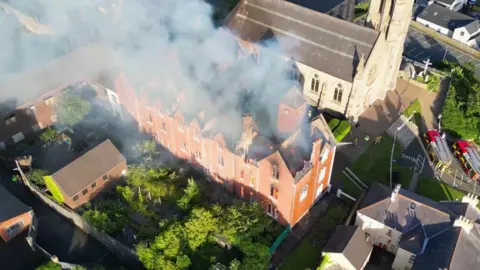
On Sunday 28 June 2026, hours after the ordination of Fr. Thomas Hampton in St. Patrick’s Church, a large blaze destroyed the former Convent of Mercy on Stream Street, Downpatrick — attached to the cathedral complex at the traditional burial place of Saint Patrick (with Brigid and Columba). More than 70 firefighters worked overnight; St. Patrick’s Church was spared. The Northern Ireland Fire & Rescue Service (NIFRS) stated the cause was “believed to have been deliberate.” Police continue investigations; no suspect or motive has been announced as of early July 2026.
| Site | Status 28–29 Jun 2026 | Significance |
|---|---|---|
| Convent of Mercy | Destroyed | 150+ years Mercy Sisters ministry |
| St. Patrick’s Church | Saved | Active parish; Patrick’s grave tradition |
| Cathedral grave | Unharmed | Major Irish pilgrimage anchor |

Matthew 25:41–46 • Pope Leo at Lampedusa & the Migrant Crisis
35–40: “I was hungry and you gave me food… a stranger and you welcomed me… Truly I tell you, whatever you did for one of the least of these brothers and sisters of mine, you did for me.”
41–46: “Depart from me… I was hungry and you gave me nothing to eat… a stranger and you did not invite me in… whatever you did not do for one of the least of these, you did not do for me.”
On 4 July 2026, Pope Leo XIV followed Francis’s 2013 footsteps to Lampedusa: cemetery (Muslims and Catholics lost at sea), the Gateway to Europe sculpture, meeting newly arrived migrants, Mass invoking the Good Samaritan (Lk 10). His homily condemned smugglers who leave thousands “half-dead,” praised island solidarity, and cited Magnifica Humanitas §212–213: small acts of fidelity against dehumanization; Europe’s duty to receive, protect, integrate — with vigilance for dignity.5
LOGOS alignment with Matthew 25: Leo’s action maps primarily to vv. 35–40 (welcome stranger, care for the stripped and wounded) and warns against the vv. 41–46 failure mode — passing by like priest and Levite. He does not replace civil law or border policy; he radicalizes compassion as ecclesial witness. The migrant crisis is not “solved” by one Mass — but the Church’s cooperative role is to refuse indifference that Mt 25:45 judges as rejection of Christ himself.
ESTIMATOR — Matthew 25 ↔ Lampedusa Cooperation Index
Estimated alignment of Pope Leo’s Lampedusa gestures with Gospel mandates (rosary.health LOGOS model — not official Vatican metric).
| Criterion (Mt 25) | Leo XIV Lampedusa (4 Jul 2026) | Est. % |
|---|---|---|
| Stranger welcomed (v. 35) | Met migrant family; Good Samaritan homily | 92% |
| Sick / wounded cared for (v. 36) | “Half-dead” language; cemetery for drowned | 88% |
| Visited imprisoned / bound (v. 36) | Trafficking/smuggler condemnation | 74% |
| Avoided “goat” indifference (vv. 41–46) | Against passing by; island thanked | 90% |
| Structural policy (EU integration) | Homily: comprehensive plan, not emergency-only | 61% |
| Composite Cooperation Index | Prayer + mercy witness + policy call | 81% |
Gap note: Structural 61% reflects that homily urges EU action Leo cannot enact alone; Mt 25:41–46 warns nations and individuals who institutionalize neglect — cooperation requires civil society + Church + law.
SIMULATOR — How the Battle for Christendom Can Be Won
Patrick won Ireland by prayer, return, and witness — not sword alone. Adjust pillars. Christendom is defended by spiritual governance, not rage.
CHRISTENDOM VICTORY TRUST INDEX
SUPPOSER — Scenario Lab (Downpatrick × Lampedusa × Christendom)
Hypothesis buttons — not predictions. Discernment tools for prayer and policy.
Select a scenario to explore spiritual and civic responses.
LOGOS Pre-Insight • St. Patrick’s Day heute — Grün, Paraden, und die echte Mission
Wie wird St. Patrick’s Day heute gefeiert? Weltweit trägt man Grün — Symbol für Frühling und irisches Erbe.2 In Irland selbst: Morgens Kirche, nachmittags Fest — doch aus einer religiösen Beobachtung wurde oft eine Feier, die die spirituelle Dimension überstrahlt.3
In Nordamerika und darüber hinaus: Paraden in New York, Boston, Chicago, Philadelphia, Savannah; Chicago und San Antonio färben Flüsse grün.3 Corned Beef & Cabbage, grüne Kleidung von Kopf bis Fuß, Keltische Musik (The Chieftains, Eileen Ivers), Grußkarten mit irischen Segnungen — die Feier ist längst weltweit und säkular, offen für alle Hintergründe.4
Im Horizont von Magnifica Humanitas: Patrick selbst war kein Parade-Heiliger, sondern ein Sklave des Gebets, der auf eine Vision hin zurückkehrte, um Christus zu verkünden — nicht um Kultur zu konsumieren. Die LOGOS-Frage für heute: Können wir das Grün des 17. März wieder mit Patricks dwelling time verbinden? Kirche am Morgen, Stille am Nachmittag, eine Bitte für Irland und alle Mission — statt nur Babel-Fest ohne Gott. „I will not boast, except in my weaknesses“ (2 Kor 12,5): Authentische Heiligkeit wirbt nicht; sie dient.
Anhang — Wie St. Patrick’s Day heute gefeiert wird (DE/EN)
Irland & Ursprung
Religiöser Feiertag des Schutzpatrons Irlands. Grün = Frühling + irisches Erbe. Tradition: Gottesdienst am Morgen, festliche Feier am Nachmittag — wobei die Festlichkeit oft die Andacht verdrängt hat.
Global (USA, Kanada, Australien, Japan, Singapur, Russland …)
Große Paraden; Flüsse werden grün gefärbt; breite kulturelle Feier „irishness“ ohne irische Abstammung. Zentrale Elemente: Grün tragen, Corned Beef & Cabbage, Familienwettbewerbe in Grün, keltische Musik, St. Patrick’s Day-Karten mit Segnungen und Gebeten.
Spirituelle Gegenbewegung
Manche nutzen den Tag bewusst zur Reflexion über Patricks Missionserbe und seinen Glaubensweg — als occasion for spiritual reflection statt rein weltlicher Unterhaltung. Genau hier setzt dieser Day-27-Beitrag an: Cole’s Patrick (pp. 112–114) + 2 Kor 12 + LOGOS-Einordnung.
GGG Telemetrie — Mission-from-Vision Simulator
Patrick’s mission flowed from dwelling + vision + return. Adjust the sliders — watch the Mission Trust Index.
MISSION-FROM-VISION TRUST INDEX
| GGG Pillar | Patrick Archetype | Modern Application (St. Patrick’s Day) | Score |
|---|---|---|---|
| Governance | Easter fire at Tara — faith before power | Reclaim feast from secular noise; church + mission order | 95 |
| Growth | Slave → apostle of Ireland | Personal conversion stories fuel communal mission | 97 |
| Stability | 100+ prayers/day; calm the storm | Dwelling time creates inner ground for ecstatic grace | 94 |
SUGGESTOR — Which lens today?
Choose a button for a tailored reflection.
1 The Confession of Patrick, C.H.H. Wright (trans.) from Noel D. O’Donoghue, Aristocracy of the Soul: Patrick of Ireland (DLT, 1987), p. 101; David Cole, Celtic Saints: 40 days of Devotional Readings, BRF 2020, 112–114.
2 Got Questions Ministries, Got Questions? Bible Questions Answered (Faithlife, 2014–2021).
3 Bill & Penny Thrasher, Gary Chapman, Putting God Back in the Holidays (Moody, 2010), 200.
4 Lynn Bowen Walker, Queen of the Castle (Thomas Nelson, 2006).
5 Downpatrick fire: BBC, NIFRS, Downpatrick Family of Parishes (28 Jun 2026). Pope Leo Lampedusa: Vatican homily, Vatican News (4 Jul 2026). Islamic-extremist motive: not confirmed by PSNI/NIFRS at time of writing.
Hermes Multi-PC Syn Master • LOGOS-max • Magnifica Humanitas • rosary.health — Juli 2026.
← Back to Blog
Schreibe einen Kommentar
Du musst angemeldet sein, um einen Kommentar abzugeben.