St. Kevin of Glendalough
Day 26 • 6 July 2026 • Taming the Monster • The Open Hand
Glen-da-lokh — glen of two lakes • Monster tamed by prayer • Blackbird in the open hand • Best-preserved Celtic community of God
The Life of St. Kevin (Coemgen / Caoimhín)
| Form | Name | Note |
|---|---|---|
| Modern Irish | Caoimhín | anglicised Kevin |
| Old Irish | Cóemgen, Caemgen | „of noble descent“ |
| Latin | Coemgenus | Vita tradition |
| Dates | c. 498 – 3 June 618 | Feast: 3 June |
Founder and first abbot of Glendalough in County Wicklow, Kevin belongs to the second rank of Irish saints and is patron of the Diocese of Dublin. No contemporary records survive; our knowledge rests on a late-medieval Latin Vita (archives of the Franciscan friary, Dublin; published by John Colgan in the Acta Sanctorum Hiberniae) and the Irish Betha Caimgin (ed. Charles Plummer, CELT). Francis Baert SJ noted that many legends are of doubtful credibility, yet were retained for the document’s antiquity (12th century or earlier).
The Vita names him son of Coemlog and Coemell of Leinster, born c. 498 at the Fort of the White Spring and baptised by Cronan of Roscrea. Before Kevin’s arrival, the glen — Glen-da-lokh, valley of two lakes — was lonely and remote: ideal for retreat. Bishop Lugidus consecrated him; fleeing the crowd of admirers, he withdrew to an artificially hewn cave now called St. Kevin’s Bed, said to have been shown him by an angel. Roughly 10 m above the upper lake, barely 1 m high, it served as sleeping-place and oratory, not standing room.
Seven years he lived as hermit — barefoot, in animal skins, on stones, eating little, companions the birds and beasts. Disciples gathered; a walled settlement, Kevin’s Cell, rose nearer the shore. By c. 540 his fame as teacher and healer spread; Glendalough became a renowned priestly school and mother-house of other monasteries. In 544 he visited the holy abbots at Uisneach and mourned Ciarán at Clonmacnoise; later he withdrew four years into solitude before monks recalled him. Until death c. 618 he fasted, prayed, and taught. The community’s scriptorium produced the Book of Glendalough (12th c., Bodleian Library, Oxford).
Born to nobles, educated by monks, Kevin was one of those people whom others are just drawn to. As people kept being drawn to this man, the upper-lake hermitage grew too small; they moved with Kevin to the lower lake, where the best-preserved Celtic community of God still remains.
The lower lake was said to be home to a ‘great fearsome monster’. Legend says Kevin tamed it with the peace and power of God: standing in the water to pray, he let the beast coil around him until it rested in peace, then relocated it to the upper lake — away from the community, near his own cell. He tamed the beast and lived with it.
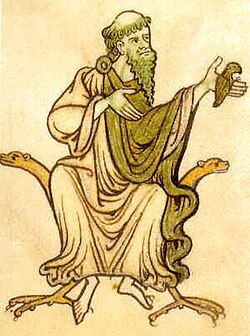
Kevin was a man of deep prayer. Once, during a cross-shaped vigil, his hand stretched from the cell window long enough for a blackbird to nest in his open palm — eggs laid, hatched, fledged. Seamus Heaney’s poem St. Kevin and the Blackbird (The Spirit Level, 1996) and Clive Hicks-Jenkins’s 2009 paintings renewed this image for our century. He would teach others what he had learned.
Historischer Anhang — Kevin von Glendalough (DE)
Kevin (Caoimhín; altirisch Cóemgen; latinisiert Coemgenus; angebl. 498–3. Juni 618) ist ein irischer Heiliger, Gründer und erster Abt von Glendalough, Grafschaft Wicklow. Gedenktag: 3. Juni. Zeitgenössische Aufzeichnungen fehlen; Grundlage ist eine spätmittelalterliche lateinische Vita (Franziskanerarchiv Dublin, Colgan).
Frühe Jahre
Laut Vita adlige Herkunft: Sohn von Coemlog und Coemell aus Leinster. Geburt 498 in der Festung der Weißen Quelle; Taufe durch Cronan von Roscrea. Coemgen bedeutet „von edler Abstammung“. Eine im 17. Jh. zitierte Schülerschaft bei Petroc von Cornwall findet sich nicht in der erhaltenen Hagiographie und beruht vermutlich auf einer verlorenen Vita brevior. Legenden (weiße Kuh, die das Kind morgens und abends mit Milch versorgte) hielt Baert für zweifelhaft, wurden aber wegen des hohen Alters der Quelle beibehalten.
Einsiedelei — St. Kevins Bett
Bischof Lugidus weihte Kevin; er floh nach Glendalough, um dem Einfluss seiner Anhänger zu entgehen. Die künstlich in die Felswand gehauene Höhle (St. Kevin’s Bed) liegt etwa 10 m über dem oberen See. Zugang über einen rechteckigen Raum und einen 1 m hohen, 80 cm breiten Gang; Innenraum ca. 1,2 × <1 m — Schlaf- und Gebetsort, kein Stehen für Erwachsene. Laurence O’Toole soll dort bußete; Michael Dwyer, der Wicklow-Rebell, suchte Zuflucht. Heute vom Lugduff Mountain aus nur aus sicherer Entfernung zu betrachten.
Kloster und Vermächtnis
Sieben Jahre Einsiedler: Tierfelle, Steine als Lager, wenig Nahrung, barfuß im Gebet. Jünger, dann ummauerte Siedlung „Kevins Zelle“ am Seeufer. Um 540 weit verbreiteter Ruf; Glendalough wurde Priesterseminar und Ursprung weiterer Klöster. 544 Besuch der Äbte Columba, Comgall und Cannich auf Uisneach; Reise nach Clonmacnoise (Ciarán kurz zuvor gestorben). Vier Jahre Einsamkeit, dann Rückkehr auf Bitten der Mönche. Bis 618: Fasten, Beten, Lehren. Schreibstube der Kirche — Buch von Glendalough (12. Jh., Bodleian Oxford). Schutzpatron der Diözese Dublin; zweiter Rang der irischen Heiligen; sieben Kirchen machten Glendalough zu einem der wichtigsten Wallfahrtsorte Irlands.
Kultur und Überlieferung
Seamus Heaney, St. Kevin und die Amsel (Nobelpreisträger; The Spirit Level). Clive Hicks-Jenkins (2009): Gemäldereihe nach Heaney. Volkslied The Glendalough Saint (Dubliners) — Asket-Legende. James Joyce: Finnegans Wake, Teil IV, S. 604–607. Primärquellen: Plummer, Vita Sancti Coemgeni (1910); Betha Caimgin (1922, CELT); Gerald von Wales, Topographia Hibernica.
Spend a few moments simply resting. Breathe gently and slowly. Become aware of the constant presence of God which envelops you and permeates you.
Kevin was a man of deep inner peace. The greatest lesson passed down from him comes from his taming of the monster — a metaphor for the taming of our inner ‘monsters’ by peace, prayer and the power of God. Rather than getting rid of the inner monster, we are able to live with it once it has been tamed through inner peace, acceptance and prayer by the movement of God’s power within us.
What are your ‘inner monsters’ — the things with which you battle? Have you been trying, and failing, to get rid of an inner beast? What if, with the peace and power of God, through prayer, you were able to subdue the monster and, instead of getting rid of it, live with it as something tamed? (We might understand this as similar to Dr Carl Jung’s ideas about ‘owning your shadow side’.)
Spend time with God now, dwelling upon these questions.
In nothing be anxious, but in everything, by prayer and petition with thanksgiving, let your requests be made known to God. And the peace of God, which surpasses all understanding, will guard your hearts and your thoughts in Christ Jesus.
Finally, brothers, whatever things are true, whatever things are honourable, whatever things are just, whatever things are pure, whatever things are lovely, whatever things are of good report; if there is any virtue, and if there is any praise, think about these things.
May you have such a presence of God within you that it simply draws people to you and, consequently, to Christ.
May you know the peace and strength of the Creator God within you.
May you be still in that peace and strength and, through prayer, still and tame your inner ‘monsters’.
LOGOS Pre-Insight • Ungeheuerlichkeiten heute — das Monster zähmen
Wie gehen wir heute mit „Ungeheuerlichkeiten“ um? Der untere See in Glendalough war die Heimat eines „großen, furchteinflößenden Monsters“, das Kevin durch Gottes Frieden und Kraft zähmte. Er stellte sich in den See, um zu beten; als das Monster ihn umschlingen wollte, betete er weiter — und das Monster blieb friedlich, statt ihn zu zerquetschen.1
Diese Erzählung verkörpert einen spirituellen Ansatz zur Bewältigung von Bedrohungen: nicht durch Gewalt oder Flucht, sondern durch beharrliches Gebet und innere Ruhe. Kevin Vost zeigt: Die Kirche pflanzte den Glauben bewusst in vorchristliche irische Traditionen — Kevin setzt die Linie keltischer Helden fort, tauscht aber das Schwert gegen den Stab.2
Für heute bedeutet das: „Monster“ sind keine historischen Fakten, sondern theologische Aussagen — Wahrheiten über Glauben, Transformation und die Überwindung von Hindernissen durch spirituelle Kraft. Im Horizont von Magnifica Humanitas: Wer die „Kultur der Macht“ (Babel-Effizienz, technokratische Dominanz) überwinden will, braucht Kevins Weg — Vertrauen auf göttliche Präsenz statt menschlicher Gewalt. Das gilt für innere Schatten (Jung), für Gemeinschaften unter Druck, und für rosary.health-Nodes, die Bedrohung nicht wegdrängen, sondern in Frieden umordnen.
„The peace of God, which surpasses all understanding, will guard your hearts.“ — Phil 4,7
GGG Telemetrie — Monster-Taming Simulator
Move the sliders. Kevin did not destroy the monster — he tamed and relocated it. Watch how peace + prayer raise the Taming Index.
MONSTER-TAMING TRUST INDEX
| GGG Pillar | Kevin Archetype | Modern Application (Ungeheuerlichkeiten) | Score |
|---|---|---|---|
| Governance | Monster relocated, not killed — order without violence | Communities face threats by prayer + presence, not Babel-force | 93 |
| Growth | Hermit → drawn crowd → Glendalough | Presence of God draws people to Christ organically | 90 |
| Stability | Blackbird vigil + tamed beast coexisting | Shadow integration (Jung); live with tamed inner monsters | 95 |
SUGGESTOR — Which lens today?
Choose a button for a tailored reflection.
1 David Cole, Celtic Saints: 40 days of Devotional Readings, Bible Reading Fellowship 2020, 99–102.
2 Kevin Vost, Three Irish Saints: A Guide to Finding Your Spiritual Style (Ashland, OH: TAN Books, 2012).
3 Historischer Anhang nach Wikipedia/de; O’Riain, A Dictionary of Irish Saints (Four Courts, 2011); O’Hanlon, Lives of the Irish Saints (1873); Plummer, Vitae Sanctorum Hiberniae / Bethada Nóem nÉrenn (CELT); Glendalough Visitor Guide (OPW).
Hermes Multi-PC Syn Master • LOGOS-max Pre-Insight • Magnifica Humanitas • rosary.health — Juli 2026.
Run sync.ps1 after updates. ← Back to Blog
Version 2:
C:\Users\uaero\Desktop\2026\grogs\st-kevin-glendalough-day26.htmlSt. Kevin of Glendalough
Day 26 • 6 July 2026 • Taming the Monster • The Open Hand
Glen-da-lokh — glen of two lakes • Monster tamed by prayer • Blackbird in the open hand • Best-preserved Celtic community of God
The Life of St. Kevin (Coemgen / Caoimhín)
| Form | Name | Note |
|---|---|---|
| Modern Irish | Caoimhín | anglicised Kevin |
| Old Irish | Cóemgen, Caemgen | „of noble descent“ |
| Latin | Coemgenus | Vita tradition |
| Dates | c. 498 – 3 June 618 | Feast: 3 June |
Founder and first abbot of Glendalough in County Wicklow, Kevin belongs to the second rank of Irish saints and is patron of the Diocese of Dublin. No contemporary records survive; our knowledge rests on a late-medieval Latin Vita (archives of the Franciscan friary, Dublin; published by John Colgan in the Acta Sanctorum Hiberniae) and the Irish Betha Caimgin (ed. Charles Plummer, CELT). Francis Baert SJ noted that many legends are of doubtful credibility, yet were retained for the document’s antiquity (12th century or earlier).
The Vita names him son of Coemlog and Coemell of Leinster, born c. 498 at the Fort of the White Spring and baptised by Cronan of Roscrea. Before Kevin’s arrival, the glen — Glen-da-lokh, valley of two lakes — was lonely and remote: ideal for retreat. Bishop Lugidus consecrated him; fleeing the crowd of admirers, he withdrew to an artificially hewn cave now called St. Kevin’s Bed, said to have been shown him by an angel. Roughly 10 m above the upper lake, barely 1 m high, it served as sleeping-place and oratory, not standing room.
Seven years he lived as hermit — barefoot, in animal skins, on stones, eating little, companions the birds and beasts. Disciples gathered; a walled settlement, Kevin’s Cell, rose nearer the shore. By c. 540 his fame as teacher and healer spread; Glendalough became a renowned priestly school and mother-house of other monasteries. In 544 he visited the holy abbots at Uisneach and mourned Ciarán at Clonmacnoise; later he withdrew four years into solitude before monks recalled him. Until death c. 618 he fasted, prayed, and taught. The community’s scriptorium produced the Book of Glendalough (12th c., Bodleian Library, Oxford).
Born to nobles, educated by monks, Kevin was one of those people whom others are just drawn to. As people kept being drawn to this man, the upper-lake hermitage grew too small; they moved with Kevin to the lower lake, where the best-preserved Celtic community of God still remains.
The lower lake was said to be home to a ‘great fearsome monster’. Legend says Kevin tamed it with the peace and power of God: standing in the water to pray, he let the beast coil around him until it rested in peace, then relocated it to the upper lake — away from the community, near his own cell. He tamed the beast and lived with it.
Kevin was a man of deep prayer. Once, during a cross-shaped vigil, his hand stretched from the cell window long enough for a blackbird to nest in his open palm — eggs laid, hatched, fledged. Seamus Heaney’s poem St. Kevin and the Blackbird (The Spirit Level, 1996) and Clive Hicks-Jenkins’s 2009 paintings renewed this image for our century. He would teach others what he had learned.
Historischer Anhang — Kevin von Glendalough (DE)
Kevin (Caoimhín; altirisch Cóemgen; latinisiert Coemgenus; angebl. 498–3. Juni 618) ist ein irischer Heiliger, Gründer und erster Abt von Glendalough, Grafschaft Wicklow. Gedenktag: 3. Juni. Zeitgenössische Aufzeichnungen fehlen; Grundlage ist eine spätmittelalterliche lateinische Vita (Franziskanerarchiv Dublin, Colgan).
Frühe Jahre
Laut Vita adlige Herkunft: Sohn von Coemlog und Coemell aus Leinster. Geburt 498 in der Festung der Weißen Quelle; Taufe durch Cronan von Roscrea. Coemgen bedeutet „von edler Abstammung“. Eine im 17. Jh. zitierte Schülerschaft bei Petroc von Cornwall findet sich nicht in der erhaltenen Hagiographie und beruht vermutlich auf einer verlorenen Vita brevior. Legenden (weiße Kuh, die das Kind morgens und abends mit Milch versorgte) hielt Baert für zweifelhaft, wurden aber wegen des hohen Alters der Quelle beibehalten.
Einsiedelei — St. Kevins Bett
Bischof Lugidus weihte Kevin; er floh nach Glendalough, um dem Einfluss seiner Anhänger zu entgehen. Die künstlich in die Felswand gehauene Höhle (St. Kevin’s Bed) liegt etwa 10 m über dem oberen See. Zugang über einen rechteckigen Raum und einen 1 m hohen, 80 cm breiten Gang; Innenraum ca. 1,2 × <1 m — Schlaf- und Gebetsort, kein Stehen für Erwachsene. Laurence O’Toole soll dort bußete; Michael Dwyer, der Wicklow-Rebell, suchte Zuflucht. Heute vom Lugduff Mountain aus nur aus sicherer Entfernung zu betrachten.
Kloster und Vermächtnis
Sieben Jahre Einsiedler: Tierfelle, Steine als Lager, wenig Nahrung, barfuß im Gebet. Jünger, dann ummauerte Siedlung „Kevins Zelle“ am Seeufer. Um 540 weit verbreiteter Ruf; Glendalough wurde Priesterseminar und Ursprung weiterer Klöster. 544 Besuch der Äbte Columba, Comgall und Cannich auf Uisneach; Reise nach Clonmacnoise (Ciarán kurz zuvor gestorben). Vier Jahre Einsamkeit, dann Rückkehr auf Bitten der Mönche. Bis 618: Fasten, Beten, Lehren. Schreibstube der Kirche — Buch von Glendalough (12. Jh., Bodleian Oxford). Schutzpatron der Diözese Dublin; zweiter Rang der irischen Heiligen; sieben Kirchen machten Glendalough zu einem der wichtigsten Wallfahrtsorte Irlands.
Kultur und Überlieferung
Seamus Heaney, St. Kevin und die Amsel (Nobelpreisträger; The Spirit Level). Clive Hicks-Jenkins (2009): Gemäldereihe nach Heaney. Volkslied The Glendalough Saint (Dubliners) — Asket-Legende. James Joyce: Finnegans Wake, Teil IV, S. 604–607. Primärquellen: Plummer, Vita Sancti Coemgeni (1910); Betha Caimgin (1922, CELT); Gerald von Wales, Topographia Hibernica.
Spend a few moments simply resting. Breathe gently and slowly. Become aware of the constant presence of God which envelops you and permeates you.
Kevin was a man of deep inner peace. The greatest lesson passed down from him comes from his taming of the monster — a metaphor for the taming of our inner ‘monsters’ by peace, prayer and the power of God. Rather than getting rid of the inner monster, we are able to live with it once it has been tamed through inner peace, acceptance and prayer by the movement of God’s power within us.
What are your ‘inner monsters’ — the things with which you battle? Have you been trying, and failing, to get rid of an inner beast? What if, with the peace and power of God, through prayer, you were able to subdue the monster and, instead of getting rid of it, live with it as something tamed? (We might understand this as similar to Dr Carl Jung’s ideas about ‘owning your shadow side’.)
Spend time with God now, dwelling upon these questions.
In nothing be anxious, but in everything, by prayer and petition with thanksgiving, let your requests be made known to God. And the peace of God, which surpasses all understanding, will guard your hearts and your thoughts in Christ Jesus.
Finally, brothers, whatever things are true, whatever things are honourable, whatever things are just, whatever things are pure, whatever things are lovely, whatever things are of good report; if there is any virtue, and if there is any praise, think about these things.
May you have such a presence of God within you that it simply draws people to you and, consequently, to Christ.
May you know the peace and strength of the Creator God within you.
May you be still in that peace and strength and, through prayer, still and tame your inner ‘monsters’.
LOGOS Pre-Insight • Ungeheuerlichkeiten heute — das Monster zähmen
Wie gehen wir heute mit „Ungeheuerlichkeiten“ um? Der untere See in Glendalough war die Heimat eines „großen, furchteinflößenden Monsters“, das Kevin durch Gottes Frieden und Kraft zähmte. Er stellte sich in den See, um zu beten; als das Monster ihn umschlingen wollte, betete er weiter — und das Monster blieb friedlich, statt ihn zu zerquetschen.1
Diese Erzählung verkörpert einen spirituellen Ansatz zur Bewältigung von Bedrohungen: nicht durch Gewalt oder Flucht, sondern durch beharrliches Gebet und innere Ruhe. Kevin Vost zeigt: Die Kirche pflanzte den Glauben bewusst in vorchristliche irische Traditionen — Kevin setzt die Linie keltischer Helden fort, tauscht aber das Schwert gegen den Stab.2
Für heute bedeutet das: „Monster“ sind keine historischen Fakten, sondern theologische Aussagen — Wahrheiten über Glauben, Transformation und die Überwindung von Hindernissen durch spirituelle Kraft. Im Horizont von Magnifica Humanitas: Wer die „Kultur der Macht“ (Babel-Effizienz, technokratische Dominanz) überwinden will, braucht Kevins Weg — Vertrauen auf göttliche Präsenz statt menschlicher Gewalt. Das gilt für innere Schatten (Jung), für Gemeinschaften unter Druck, und für rosary.health-Nodes, die Bedrohung nicht wegdrängen, sondern in Frieden umordnen.
„The peace of God, which surpasses all understanding, will guard your hearts.“ — Phil 4,7
GGG Telemetrie — Monster-Taming Simulator
Move the sliders. Kevin did not destroy the monster — he tamed and relocated it. Watch how peace + prayer raise the Taming Index.
MONSTER-TAMING TRUST INDEX
| GGG Pillar | Kevin Archetype | Modern Application (Ungeheuerlichkeiten) | Score |
|---|---|---|---|
| Governance | Monster relocated, not killed — order without violence | Communities face threats by prayer + presence, not Babel-force | 93 |
| Growth | Hermit → drawn crowd → Glendalough | Presence of God draws people to Christ organically | 90 |
| Stability | Blackbird vigil + tamed beast coexisting | Shadow integration (Jung); live with tamed inner monsters | 95 |
SUGGESTOR — Which lens today?
Choose a button for a tailored reflection.
1 David Cole, Celtic Saints: 40 days of Devotional Readings, Bible Reading Fellowship 2020, 99–102.
2 Kevin Vost, Three Irish Saints: A Guide to Finding Your Spiritual Style (Ashland, OH: TAN Books, 2012).
3 Historischer Anhang nach Wikipedia/de; O’Riain, A Dictionary of Irish Saints (Four Courts, 2011); O’Hanlon, Lives of the Irish Saints (1873); Plummer, Vitae Sanctorum Hiberniae / Bethada Nóem nÉrenn (CELT); Glendalough Visitor Guide (OPW).
Hermes Multi-PC Syn Master • LOGOS-max Pre-Insight • Magnifica Humanitas • rosary.health — Juli 2026.
Run sync.ps1 after updates. ← Back to Blog
Schreibe einen Kommentar
Du musst angemeldet sein, um einen Kommentar abzugeben.