The 40-Day Journey (Compact Menu)
Full detailed readings for each day are in the RTF plan and previous sections. This is a quick reference menu. Focus is on today’s saint (Brigid) and the interactive board for „which powers rule“.
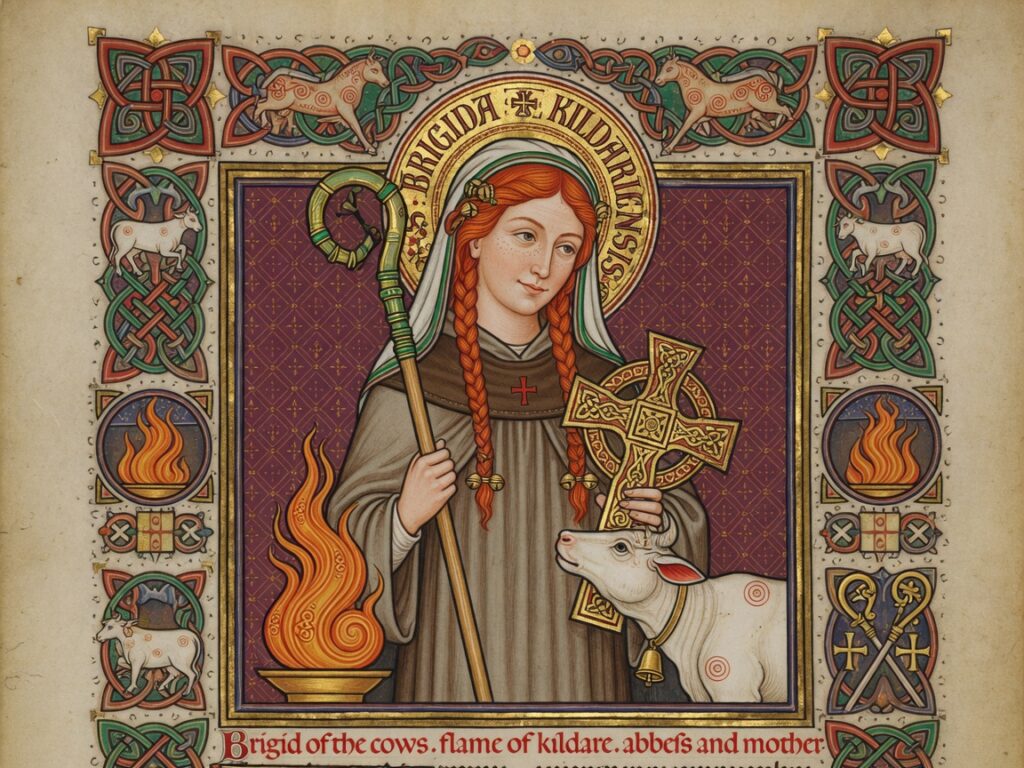
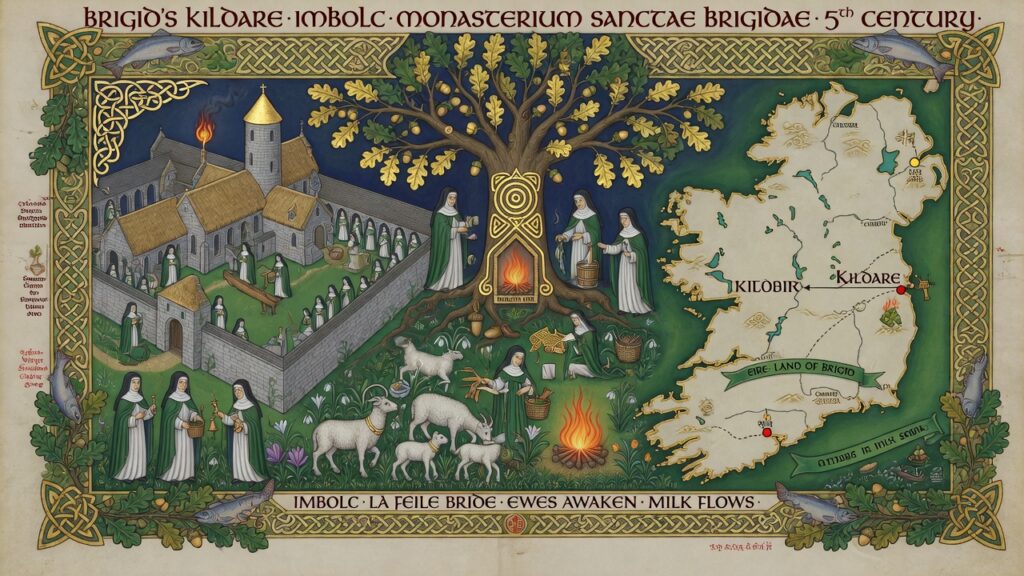
BRIGID OF KILDARE — THE GENEROUS ANAM CHARA


The feast day of Brigid of Kildare, celebrated just before the Christian festival of lights, is also the first day of Imbolc (meaning something like ‘Ewe’s milk’), the beginning of the Celtic season of spring, passing from the darkness of the season of death (winter) and celebrating the coming of new life. Imbolc is a very feminine festival, with great emphasis on the importance of women in the community.
Brigid of Kildare was well known as an embodiment of the Celtic traditions of both the anam chara (she is famed for saying that ‘a person without an anam chara is like a body without a head’) and generosity.
When Brigid was a young girl, her father was so afraid that she would make the family bankrupt by giving everything away that he tried to marry her off to a local chieftain. He took her to the chieftain in a beautiful carriage, and left her in it while he went to speak to the chieftain. While he was away, Brigid gave the carriage away to some poor people who passed by. When her father returned, he was furious, but the chieftain was so impressed by her generosity that he released her from the marriage agreement and let her go to live a life of service to God and the poor.
Brigid founded the monastery at Kildare, which became a great center of learning, art, and hospitality. She was known for her miracles of provision, especially with food and drink.
WIE LÄSST SICH DIE WUNDERBARE VERMEHRUNG MIT DER KELTISCHEN HEILIGEN VERBINDEN?
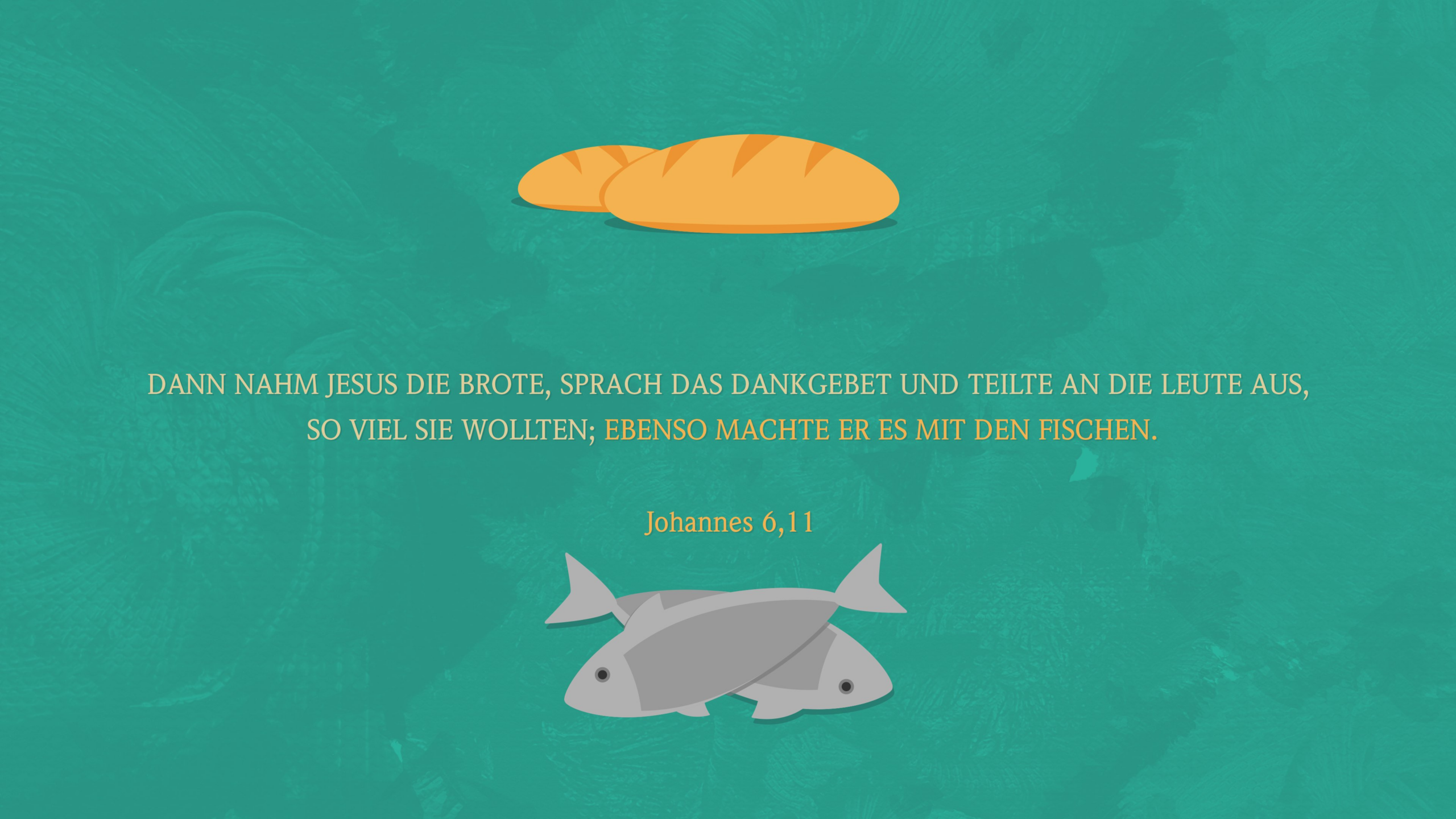
Die wunderbare Vermehrung lässt sich auf mehreren Ebenen mit der heiligen Brigid verbinden. Viele ihrer Wunder betreffen die wunderbare Bereitstellung von Nahrung und Getränken—Butter, Milch und besonders Bier.1 Diese Wunder spiegeln direkt das Wirken Jesu wider: In einem Fall versorgte sie achtzehn Kirchen in ihrer Gegend mit Bier aus einem einzigen Fass für die gesamte Zeit von Gründonnerstag bis zum Ende der Osterzeit, was das Wunder der Brotvermehrung widerspiegelt.1
Das tiefere theologische Muster offenbart sich in der Art, wie Brigid Mangel in Fülle verwandelt. Sie melkte eine Kuh dreimal an einem einzigen Tag—entgegen der Gewohnheit—und erhielt von dieser einen Kuh das, was sie normalerweise von drei besten Kühen erwartet hätte.2 Als Aussätzige um Bier baten, segnete sie Badewasser im Vertrauen auf ihren Glauben und verwandelte es in ausgezeichnetes Bier; derselbe Herr, der Wasser zu Wein in Kana verwandelte, tat dies hier durch den Glauben dieser gesegneten Frau.2
Besonders aufschlussreich ist die kulturelle Dimension: Gastfreundschaft war eine äußerst wichtige Tugend bei den alten Kelten, und Bier war ihre physische Manifestation.1 Brigids Wunder der Vermehrung sind daher nicht bloße Wunderzeichen, sondern Ausdruck ihrer Liebe und ihres Dienstes. Ihr Stil als Äbtissin von Kildare war der einer vollkommenen Gastgeberin, die Große und Kleine mit gleicher Wärme willkommen hieß, großzügig diente und jedes Bedürfnis erfüllte.3 Ihre Wunder demonstrieren, wie göttliche Kraft durch menschliche Großzügigkeit wirkt—eine Vermehrung, die nicht nur materielle Güter betrifft, sondern die Gegenwart Gottes selbst in der Fürsorge für die Bedürftigen offenbart.
2 Cogitosus, „The Life of St. Brigit the Virgin“, in Celtic Spirituality, hg. von Bernard McGinn, übers. von Oliver Davies, The Classics of Western Spirituality (New York; Mahwah, NJ: Paulist Press, 1999), 125–126.
3 „The Festive Abbess“, Christian History Magazine-Issue 60: How the Irish Were Saved (Carol Stream, IL: Christianity Today, 1998). [Siehe hier.]
LOGOS MAX PRE-INSIGHT: DIE VERMEHRUNG ALS ZEICHEN DER GÖTTLICHEN GASTFREUNDSCHAFT UND DER ANAM CHARA
Die wunderbare Vermehrung in Brigids Leben ist nicht nur eine Wiederholung der biblischen Wunder (Brot und Fische, Wasser zu Wein), sondern eine Verkörperung der keltischen Seele: die Gastfreundschaft als Manifestation der Gegenwart Gottes. Bei den Kelten war die Gastfreundschaft heilig; das Bier war das Zeichen der Fülle und der Gemeinschaft. Brigid verwandelt den Mangel (eine Kuh, ein Fass, Badewasser) in Überfluss, weil sie die anam chara lebt – die Seele, die mit Gott und den Menschen verbunden ist, teilt, was sie hat, und Gott multipliziert es.
Dies verbindet sich mit den früheren Tagen: Die Charismen (Brendan) werden durch die Demut und Gleichheit (Aidan) fruchtbar, die kulturelle Erlösung (Cædmon) macht die „Edelsteine“ singend, die 40 Tage des Gebets (Cedd) bereiten den Boden für das Neue. Bei Brigid wird die Vermehrung zum Zeichen der Großzügigkeit, die die Gemeinschaft nährt – die anam chara, die „Kopf“ für den „Körper“ ist. Die feminine Dimension von Imbolc (Frühling, neue Leben, Frauen in der Gemeinschaft) ergänzt die „männlicheren“ Aspekte der früheren Heiligen und zeigt die Fülle der keltischen Spiritualität.
In unserer Zeit, in der Ressourcen knapp scheinen (Migration, wirtschaftliche Drücke, kulturelle Verdrängung in Irland und UK), ist Brigids Vermehrung eine Einladung: Der Glaube und die Großzügigkeit (nicht das Horten) sind der Weg, auf dem Gott die Gaben multipliziert. Die Enzyklika Magnifica Humanitas betont die gleiche Würde und die integrale Entwicklung – Brigid zeigt, wie das in der Praxis aussieht: alle willkommen heißen, teilen, und die Gegenwart Gottes in der Fürsorge erleben. Die „Sturmbewegte“ (wie in Jesaja bei Caedmon) werden getröstet durch die Fülle, die aus dem Glauben kommt.
MEDITATION
Brigid was an embodiment of generosity and the anam chara. She gave what she had, and God multiplied it. She was the „soul“ for many bodies, the hostess who welcomed great and small with equal warmth.
How generous are you with what you have – time, resources, attention? Do you believe that God can multiply what you share? Are you an anam chara for others, or do you run the risk of being „a body without a head“?
Spend time with God now, dwelling upon these questions.
SCHRIFT
„Gebt, so wird euch gegeben werden; ein gutes, gedrücktes, gerütteltes und überfließendes Maß wird man in euren Schoß geben. Denn mit dem Maß, mit dem ihr messt, wird man euch wieder messen.“ (Lukas 6,38)
„Ein Freund liebt allezeit, und ein Bruder wird für die Not geboren.“ (Sprüche 17,17)
SEGEN
May the generosity of God flow through you.
May your soul be connected with the souls of others as anam chara.
May God multiply what you give to abundance for the community.
For our Overchampionship: Brigid shows that multiplication does not come through hoarding, but through sharing. The gifts of the Spirit (Brendan), the humility and equality (Aidan), the cultural redemption (Cædmon, Cedd) – all of this becomes abundance when we live the anam chara like Brigid and practice hospitality as a sign of God’s presence. In the „storm-tossed“ times (migration, unrest, cultural erosion in Ireland and the UK), the invitation is to give, to share, to believe – and to see how God turns the little into the much. The Overchampionship is not in spectacle, but in the quiet multiplication of love and care that turns „rejected stones“ into cornerstones.
THE ENDURING LEGACY: SPIRITUAL & HANDCRAFTING SKILLS OF THE CELTIC SAINTS — OUTCOMES TODAY
The Irish and Celtic saints were not only spiritual giants; they were practical builders of civilization. Their monasteries were not retreats from the world but powerhouses that transformed it. The same hands that copied psalters and prayed the hours also cleared forests, plowed fields, forged tools, and taught the next generation.
Founding Monasteries
From Iona to Lindisfarne, Clonmacnoise to Glendalough, Bangor to Applecross — the saints founded self-sustaining communities that became the heart of early medieval Europe. These were not mere religious houses; they were towns, hospitals, schools, and economic hubs. Today their legacy lives in the revival of intentional communities, eco-villages, and new monastic movements that seek to live the Gospel in shared life, hospitality, and simplicity.
St. Brigid
Schreibe einen Kommentar
Du musst angemeldet sein, um einen Kommentar abzugeben.