
COLUMBA
of IONA
10th June • d. 597
“He who says he remains in him ought himself also to walk just like Christ walked.”
fleeting trophies, we begin a 40-day pilgrimage of memorial,
contemplation and holy “matches” — virtues scored in silence, goals of
mercy, the cup of the Dove. Columba leads us from exile into mission.
Join the real victory.
dove of the Church. Poet, prophet, scribe and exile, he carried the
light of Christ across the sea to the white island of angels. From the
sorrow of a copyright battle rose a mission that would shape nations.
THE LIFE OF THE DOVE

Columba was born into the nobility in the
north of Ireland, possibly in line to be the High King of Ireland. He
was well known as an organiser, poet/song writer and prophet. He planted
a great many monasteries in Ireland before being involved in a dispute
over copyright while he was at the monastery in Clonard, under Finnian.
As part of his creative meditations, Columba copied out the
book of Psalms from Finnian’s own handwritten copy. When Columba was due
to leave, he wished to take his copy of the Psalms with him, but, as he
had copied Finnian’s personal margin notes as well, Finnian was not
happy for the book to leave Clonard. A legal battle followed, in which
the High King of Ireland, Diarmait mac Cerbhiall, decided that Columba’s
copy was to stay in Clonard. The dispute escalated into military battle
and, as a result, when the battle was over, Columba was banished from
Ireland. He vowed to convert as many souls to Christ as there were
soldiers who had lost their lives in the copyright battle.
Columba sailed from the north coast of Ireland to the Irish-owned part of what we now call Scotland.38
He landed on other isles before settling on Iona, a place from which he
could not see his beloved Ireland—knowing that if he lived on an isle
where he could see Ireland, he would be too tempted to return.
On Iona, Columba founded what became his most famous
monastery and mission centre. It was from here, around a generation
after Columba died, that Aidan was sent to Lindisfarne and became the
‘apostle to the English’; many others, too, gained their training in
Iona.
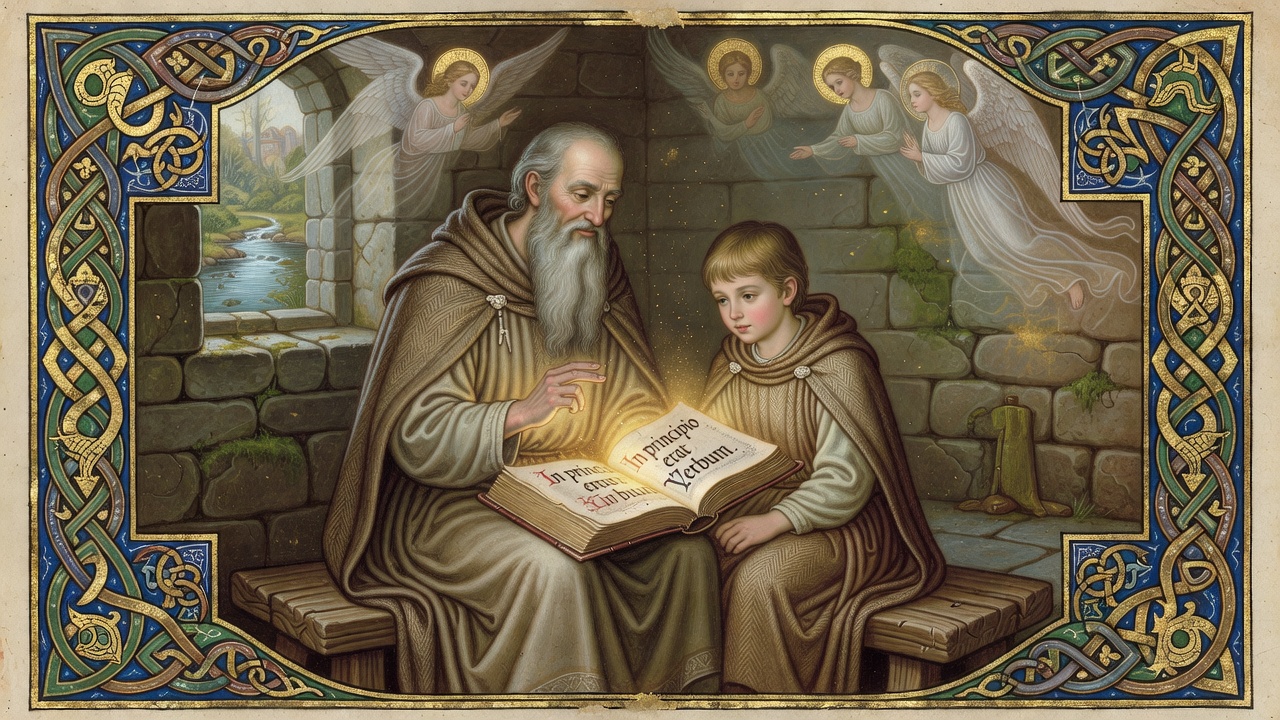
Columba was well known for going away for long periods of
time to pray and converse with angels, and many of these encounters were
witnessed by other monks on Iona, who saw the angels with Columba. On
one occasion, when he shut himself in a hut for a length of time,
blinding light could be seen through the cracks in the door and through
the keyhole. His face is reported to have shone when he had been with
God, just as the face of Moses did (Exodus 34:29–35).
Columba’s prophetic visions were
famous… On one occasion, he sat writing in his hut on Iona when his
countenance suddenly changed and he shouted, ‘Help! help!’ Two monks who
were near the open door were alarmed and asked, ‘Why do you cry out?’
“I have directed the angel of the
Lord, who was just now standing among you, to go quickly and help one of
the monks who has fallen from the top of a roof in the Plain of the Oak
Wood… How wonderful beyond words is the swift motion of an angel…
Later, they learned that a man had indeed fallen from that great height,
but he had broken no bones and did not even feel a bruise.”39
The Spirit of God was
upon Columba greatly. He was a great prophet, teacher, leader and
miracle worker, as well as being known for seeing God in creation.
38 Dál Riata… 39 Wentworth Huyshe, The Life of Saint Columba by Adamnan (1939), Book 3, ch. 15.
MEDITATION
Spend a few moments simply resting. Breathe gently and
slowly. Become aware of the constant presence of God which envelops you
and permeates you.
Columba’s prophetic ministry and angelic encounters came
through his regular practice of withdrawing from the busy life of the
monastery and mission work to engage in contemplative prayer.
How much time do you
spend in contemplative prayer? This is not a speaking type of prayer
(audibly or internally), but a dwelling in the divine presence, a
resting with the beloved, a ‘prolonged immersion in the rivers of
tranquillity which flow from God into the whole universe and draw all
things back to God’.40
In what ways might you be able to deepen your times of
stillness with God? How might it increase your ability to hear God’s
voice and encounter angels?
Spend time with God now, dwelling upon these questions.
SCRIPTURE
“But whoever keeps his word, God’s
love has most certainly been perfected in him. This is how we know that
we are in him: he who says he remains in him ought himself also to walk
just like [Christ] walked.”
— 1 JOHN 2:5–6
“But Jesus often withdrew to lonely places and prayed.”
— LUKE 5:16 (NIV)
BLESSING
May you, like Columba, seek to do good, even from the results of wrong.
May you be so drawn into the presence of God that your face shines from his presence.
May you be a great inspiration for others in their walk with God.
IN OUR OWN DAY
The Battle of the Books is
one of history’s strangest origin stories for a great missionary
movement. A dispute over a copied psalter and its marginalia escalated
into deadly conflict. Columba’s exile became the seedbed of Christianity
across Scotland and northern England. From the “wrong” came the sending
of Aidan to Lindisfarne a generation later.
Today we live amid our own “copyright battles” —
digital copying, AI training on books and art, ownership of words and
songs. Columba reminds us that the Word of God cannot be chained. What
began as a personal loss and national shame became the evangelisation of
nations. God is still in the business of turning exile into mission.
TODAY’S FACTS • 2026
- Iona remains one of the world’s great “thin places”.
Multiple organised pilgrimages sail to the island every summer,
including major groups in June 2026 (Washington National Cathedral,
Missional Wisdom Foundation, John Philip Newell, and others). - The Iona Community (founded 1938 by George MacLeod)
continues Columba’s legacy of prayer, peace and social justice from the
restored Abbey. - Modern seekers come precisely for what Columba modelled:
withdrawal, contemplative stillness, and the sense that heaven and
earth are very close.
Contemplation in an age of noise.
Columba regularly withdrew “to lonely places”. Jesus did the same. In
our always-on world, the invitation is the same: prolonged immersion in
the rivers of tranquillity. Many who visit Iona today speak of the same
angelic nearness and shining faces that the monks once witnessed.
Seeing God in creation.
Columba was famous for it. In 2026, with ecological crisis and renewed
interest in Celtic creation spirituality, this witness is urgently
needed. The same island that once sent missionaries now draws people
back to listen to the earth and the Spirit together.
TERMS & SYMBOLS OF THE AGE
When we speak of the world Columba entered, we often hear the words pagan, heathen and later Vikings.
These are not simple labels of “bad religion.” They describe living
spiritual landscapes that the Celtic saints both challenged and
sometimes quietly baptised.
The indigenous Irish script was Ogham
(᚛ᚑᚌᚐᚋ᚜), often called the Celtic tree alphabet or “runes of the Gael.”
Each letter is a notch or stroke along a central stem-line, frequently
carved on stone pillars or the edges of crosses. Columba’s Ireland and
the Pictish north used such symbols alongside Latin learning. On high
crosses and Pictish symbol stones one sees spirals (the journey of the
soul), interlace (eternity and the interconnected web of creation), and
animals (the wild creatures who also belong to God). Later, Norse
runestones appeared in the Hebrides and on Iona itself after the Viking
raids — the old stone language meeting the new. The “runes” were never
mere decoration; they were prayers and memory made visible in stone.
See also the great
high crosses of Iona and the Pictish stones of eastern Scotland for
living examples of sacred Celtic symbol-language.
Columba’s own feast (9 June) stands only two weeks before the great summer feast of St John the Baptist
(24 June — Midsummer / Alban Hefin in some Celtic calendars). In many
Celtic lands the solstice fires of midsummer were not extinguished but
re-lit in honour of the Forerunner who pointed to the true Light. Other
turning points in the Celtic Christian year include:
- Imbolc / St Brigid (1 Feb) — the quickening of spring and the first lambs
- Beltane (1 May) — the great fire festival of purification and new life
- Lughnasadh / Lammas (1 Aug) — first fruits and the harvest begun
- Samhain / All Saints (1 Nov) — the thin veil between worlds
These feasts were not “pagan survivals” but the Church’s joyful claim that every season belongs to Christ.

Songs of the Bards & Choirs of Iona
Lift Your Voice with Columba
Also beloved
on this feast: “The King of Love My Shepherd Is” (to the ancient Irish
tune “St Columba”) and Benjamin Britten’s “A Hymn of St Columba”.
Feast Days of the Celtic Saints
From Celtic Saints: 40 days of Devotional Readings — David Cole (BRF 2020)
These dates mark the day each saint was “born into glory” — their earthly departure celebrated as heavenly arrival.
The book presents forty saints across the liturgical year. The dates above are the principal feast days featured.
BOISIL — MENTOR AND SEER
We know very little about Boisil except that he was the prior
of Melrose and a teacher and friend of Cuthbert, but he certainly had a
great impact on Christian spirituality in the Northumbrian kingdom, not
least through his influence over Cuthbert, with whom he developed an
anam chara (soul friend) relationship.
Boisil often went out walking through the local villages,
preaching and teaching about Christ and about living as an authentic
Christian. He encouraged people to live out everything he taught them,
not just by what he said but by his example. Like many of the great
Celtic saints, he preached only what he was already living, not
expecting anyone to behave in ways that he himself did not. ‘It was the
custom amongst the English people at that time, when a clerk or a priest
came to a village, for all to gather … to hear the Word.’
Boisil’s life illuminates what it means to answer a calling to
mentor and guide. As prior of Melrose and teacher to Cuthbert, he shaped
Christian spirituality across the Northumbrian kingdom through a
relationship of spiritual friendship—what the Celtic tradition called an
anam chara or soul friend. His influence extended far beyond this
singular mentorship.
What made Boisil’s guidance transformative was his refusal to
separate teaching from living. He moved through villages preaching about
Christ and authentic Christian living, encouraging people to embody his
teachings through both his words and his example. Unlike some teachers,
he never demanded behavior from others that he wasn’t already
practicing himself. This integrity created credibility—people recognized
something genuine in him.
Boisil also possessed a prophetic dimension to his mentoring.
He envisioned Cuthbert’s future as a bishop, a calling Cuthbert
initially resisted but which ultimately came to pass. Yet his greatest
gift may have been his final act of formation. When plague struck,
Boisil told the recovering Cuthbert they had only seven days left
together, and he proposed they spend that time reading and reflecting on
John’s Gospel—seeking not intellectual complexity but the sincerity of
faith working through love. Though Boisil died, his influence persisted
through Cuthbert, who eventually surpassed his master in impact on
others.
The pattern is clear: God
calls mentors to embody what they teach, to see potential in those they
guide, and to invest intensely in their formation—knowing that faithful
mentoring multiplies across generations. Who is God calling you to guide
with this same integrity and vision?
Source: David Cole, Celtic Saints: 40 days of Devotional Readings, BRF 2020, p. 24 (with additional material from Alban Butler, The Lives of the Fathers, Martyrs and Other Principal Saints).
DAILY VERSE — ACTS 2:38 FF (PENTECOST RESPONSE)
“Repent, and be baptized every one of you in
the name of Jesus Christ for the forgiveness of your sins, and you will
receive the gift of the Holy Spirit. For the promise is for you, for
your children, and for all who are far away, everyone whom the Lord our
God calls to him.” (Acts 2:38–39)
Pre-insight explanation from LOGOS Max:
Keinen Augenblick ist Petrus im unklaren darüber, was er diesen vielen
heilsbegierigen Menschen antworten soll, er zögert nicht, allen ohne
Unterschied sofort die Gabe des Heiligen Geistes zu verheißen, die sie
selbst gerade empfangen haben. Nur zwei Voraussetzungen nennt er: Es muß
die große „Umsinnung“ eintreten, und damit verbunden muß es zur Taufe
auf den Namen Jesu Christi kommen. Petrus denkt hier an die Wassertaufe,
so wie der Täufer sie vollzog und wie auch die Jünger Jesu sie ausgeübt
haben (Joh. 3, 22), nur mit dem Unterschied, daß diese Taufe auf den
Namen Jesu hin geschah.
Die Verheißung betraf aber nicht nur die Gabe des Heiligen
Geistes, sondern zugleich und damit eng verbunden die Vergebung der
Sünden, ja die Befreiung von der Sünde. Das griechische Wort aphesis
bedeutet noch mehr als Vergebung der Sünde, d.h. Bedeckung der Schuld,
es schließt auch das Freiwerden von der Macht der Sünde in sich.
Source: Die Bibel mit Erklärungen, Brunnen Verlag, 16. Auflage, p. 209.
Boisil lived this out: authentic
repentance (Umsinnung), baptismal life, and the power of the Spirit
released through mentoring that set others free. His final days with
Cuthbert reading John’s Gospel were a living Pentecost — the Spirit
poured out through friendship, prophecy, and the Word.
THE ENDURING LEGACY: SPIRITUAL & HANDCRAFTING SKILLS OF THE CELTIC SAINTS — OUTCOMES TODAY
The Irish and Celtic saints were not only spiritual giants;
they were practical builders of civilization. Their monasteries were not
retreats from the world but powerhouses that transformed it. The same
hands that copied psalters and prayed the hours also cleared forests,
plowed fields, forged tools, and taught the next generation.
Founding Monasteries
From Iona to Lindisfarne, Clonmacnoise to Glendalough, Bangor
to Applecross — the saints founded self-sustaining communities that
became the heart of early medieval Europe. These were not mere religious
houses; they were towns, hospitals, schools, and economic hubs. Today
their legacy lives in the revival of intentional communities,
eco-villages, and new monastic movements that seek to live the Gospel in
shared life, hospitality, and simplicity.
Building Streets & Infrastructure
The “Street of the Dead” on Iona, pilgrim paths across Ireland
and Scotland, roads connecting monasteries — the saints literally built
the infrastructure of travel and pilgrimage. Their handcrafting skills
in stone, wood, and metal created the high crosses, oratories, and
scriptorium tools that still inspire. Modern outcomes: renewed interest
in pilgrimage routes (Camino, Iona paths), sustainable architecture, and
community-led infrastructure projects rooted in beauty and purpose
rather than profit.
Starting Agriculture & Trade
Monks cleared land, introduced new crops and livestock breeds,
developed milling and brewing, and created trade networks that linked
Ireland, Scotland, England, and the Continent. They turned “waste”
places into gardens. Today we see this in the resurgence of regenerative
farming, monastic gardens and breweries, fair-trade initiatives
inspired by Celtic hospitality, and the theological conviction that
caring for creation is part of the Gospel (echoing Columba’s seeing God
in nature).
Literature & Education
The greatest handcrafting of all was the preservation and
creation of books. Scriptoria copied the Scriptures and classical texts,
illuminated them with the Logos in color and knot, and educated
generations in Latin, Greek, theology, poetry, and science. Without the
Celtic saints, much of Western learning would have been lost. Boisil’s
final act — reading John with Cuthbert — was education as spiritual
formation. Modern outcomes: the revival of classical Christian
education, homeschooling and new monastic schools, the enduring power of
beautiful books and illuminated art, and a counter-cultural emphasis on
deep reading and formation over information.
For the Overchampionship:
The Celtic saints did not win by spectacle.
They won by building slowly, teaching faithfully, farming sustainably,
writing beautifully, and mentoring the next generation in the power of
the Spirit. Their “victories” are still bearing fruit 1,400 years later.
On this 40-day journey, ask: What am I building, planting, writing, or
mentoring that will outlast the noise of the world’s championships?
A 40-Day Celtic Saints Overchampionship
Day 1: 9 June —
Columba • Day 2: 10 June — Boisil (feast 7 July) • Spiritual counter to
the soccer World Cup • Follow the spirit of David Cole’s devotional
10 JUNE — BOISIL
you teach. Read the Gospel with someone this week. The Spirit
multiplies through faithful friendship.
circle: from Iona the light still goes out. What will you carry forward?
The championship is won in the daily choice to shine.
Overchampionship Scorecard & Notes (editable)
Today I choose authentic mentoring. I will embody one teaching and seek or offer soul-friendship (anam chara).Acts 2:38 Reflection: Umsinnung (repentance) and freedom from sin’s power — how does Boisil’s integrity model this for me?
Virtue Goal scored today: _______________________________
Reflection: With the Holy Spirit gift and Boisil’s example of living what he taught, I notice…
directly. Log daily goals of prayer, soul-friendship, integrity.
Save/print to preserve your championship record.


INTERACTIVE SIMULATION BOARD: WHICH POWERS RULE?
Relate the
ancient maps (Dál Riata & the 1st-century Holy Land) to modern Iona.
Select powers and entities, place their influence on the maps, then run
the simulation to discern which forces truly rule across time — and how
the Logos still governs the thin places.
POWER / ENTITY PALETTE — Click to select, then click a map to place influence
Selected: None — click an entity above


CURRENT PLACEMENTS (click to remove)
This board is a tool for the 40-day pilgrimage: discern the powers, then choose the way of the Dove.
Key Monasteries Founded by the Celtic Saints • Click for Maps & Anam Chara
Iona (Columba, 563)
The mother house. “Thin place” of angels and the Dove.
Old Melrose (Boisil & Cuthbert)
Boisil’s home. Soul-friendship forged here. Anam Chara in action.
Lindisfarne (Aidan, Cuthbert, Finan)
Apostle to the English. “Holy Island”.
Glendalough (Kevin)
Valley of two lakes. Extreme hospitality & creation care.
Clonmacnoise (Ciaran)
Great school on the Shannon. Literature & learning.
ANAM CHARA — Soul Friend (Soul Mate)
Click for full explanation (Boisil & Cuthbert model)
These monasteries were
powerhouses of spiritual life and handcraft: they built communities,
farmed, traded, copied books, and educated Europe. Their legacy is still
visible in the landscape and in today’s Celtic revival.
Iona — Founded by St Columba (563)

Location: Inner Hebrides, Scotland. “The Isle of Columba” (Ì Chaluim Chille).
Significance: Columba’s exile became the
launchpad for the conversion of Scotland and northern England. Site of
angelic encounters, the writing hut (now archaeologically confirmed),
high crosses, and the “Street of the Dead.”
Legacy today: Restored abbey, Iona Community, world-famous pilgrimage destination and “thin place.”
Old Melrose — Home of Boisil & Cuthbert

Location: By the River Tweed, Scottish Borders (near modern Melrose).
Significance: Founded by St Aidan (c. 635).
Boisil was prior, then abbot. Here he mentored Cuthbert as anam chara,
prophesied his future, and spent his last seven days reading John’s
Gospel with him.
Legacy: The site of profound soul-friendship
and the transmission of the Spirit from one generation to the next.
Later Cistercian abbey nearby.
Lindisfarne (Holy Island) — Aidan, Cuthbert, Finan

Location: Tidal island off Northumberland, England.
Significance: Founded by St Aidan (sent from
Iona in 635) as base for the mission to the English. Home and bishopric
of St Cuthbert and later St Finan. Famous for the Lindisfarne Gospels
and the “apostle to the English.”
Legacy: Still a living pilgrimage site with a
causeway that appears and disappears with the tides — a perfect image
of the “thin place.”
Glendalough — Founded by St Kevin (6th c.)

Location: Glendalough (Valley of Two Lakes), County Wicklow, Ireland.
Significance: Kevin’s hermitage grew into a
major monastic city. Famous for extreme hospitality (the blackbird
legend), asceticism, and harmony with creation.
Legacy: One of Ireland’s most visited
monastic sites, with round tower, churches, and a powerful sense of
sacred wilderness still intact.
Clonmacnoise — Founded by St Ciaran (6th c.)

Location: On the River Shannon, County Offaly, Ireland.
Significance: “The University of the West.”
Major center of learning, art (high crosses, crosses of the Scriptures),
and pilgrimage. Ciaran died young; the community became one of the
greatest in Europe.
Legacy: Extraordinary collection of high
crosses, round tower, and cathedral ruins. Symbol of Celtic learning and
the marriage of faith and culture.
ANAM CHARA — Soul Friend (Soul Mate in the Spirit)
Anam Chara (Irish: “soul friend” or “soul mate”) is one of the most beautiful and distinctive gifts of Celtic Christianity.
It is a deep, intentional spiritual friendship in which two
people commit to walking together in the presence of God. The anam chara
is:
- A companion for confession and healing (before the formal sacrament of penance was widespread).
- A mirror who sees your true self and calls you to it.
- A guide and prophet — someone who can speak hard truths in love.
- A fellow pilgrim who prays with and for you, shares the journey, and helps you discern the will of God.
Boisil was Cuthbert’s anam chara. He recognized
the young man’s calling the moment he arrived at Melrose (“Behold, the
servant of God”). He trained him, prophesied his future as bishop, and
in his final days poured the Gospel of John into him day by day — not as
information, but as formation in love.
“A person without an anam chara is like a body without a head.” — old Irish saying (paraphrased in Celtic tradition)
In our overchampionship journey, ask:
Who is God giving me as anam chara? Am I willing to be one for someone
else? This is how the Spirit multiplies — not through programs, but
through faithful soul-friendship.
This page is a living editor. All sections (notes,
scorecard, reflections) are directly editable in the browser. Save or
print to keep your 40-day record.
FOOTNOTES
- 38 Dál Riata (also Dalriada or Dalriata)
was an Irish kingdom which included parts of western Scotland and
north-eastern Ulster in Ireland. In the late sixth to early seventh
century it encompassed roughly what is now Argyll and Lochaber in
Scotland and County Antrim in Ulster. ↩ - 39 Wentworth Huyshe, The Life of Saint Columba by Adamnan (George Routledge & Sons, 1939), Book 3, ch. 15. ↩
- 40 Thomas Merton, New Seeds of Contemplation (Shambhala, 2003), p. 270. ↩
PAGAN
the early Christian centuries it simply meant people who still followed
the old local gods and nature spirits of the countryside, rather than
the new faith of the towns and the Empire. It was not originally a term
of abuse — merely a description of where and how people lived their
religion. The Celtic saints often met these people with respect, wonder
at creation, and a gentle invitation to the fuller light of Christ.
companions did not arrive in a spiritual vacuum; they entered a world
already alive with sacred wells, holy hills, and seasonal fires.
HEATHEN
uncultivated land. It carried a similar meaning to “pagan”: those who
lived on the wild, untilled margins rather than in the Christianised
settlements. In the mouths of later chroniclers it sometimes became
harsher, but at root it described people whose spiritual life was still
rooted in the land, the ancestors, and the old stories. Many Celtic
saints discovered that the “heathen” already knew something of the
sacredness of creation.
VIKINGS
who raided, settled, and eventually intermarried across the Celtic
world. Iona itself was attacked several times; the monks carried
Columba’s relics to safety more than once. Yet the Viking Age also
brought new stone-carving traditions — runic inscriptions appear on
crosses and grave slabs in the Hebrides and on Iona. The meeting of
Celtic interlace and Norse runes produced some of the most beautiful
hybrid monuments in Scotland. The “heathen” Northmen became, in many
places, Christian — and the old Celtic saints’ stories continued to
shape them.
wp:html /–>
Fest des Heiligen Columba · 9. Juni
Columba von Iona
Keltische Andacht & Heilung
„Christus ist mein Druide“ — interaktive Meditationen aus der Tradition der keltischen Mönche für Geist, Seele und Körper.
9. Juni 521–597 n. Chr.
Geschichte & Heilung
Wer war Columba?
Columba (irl. Colm Cille, „Taube der Kirche“) wurde 521 in Irland geboren und gründete 563 das Kloster auf der schottischen Insel Iona — ein Zentrum keltischer Spiritualität, das ganz Nordeuropa missionierte. Er war Dichter, Schreiber, Heiler und Mystiker in einem.
Die keltische Mönchstradition verstand Gesundheit als Einheit: Körper, Geist und Gemeinschaft. Gebete wurden in Atemrhythmen verankert, die Tageszeiten heiligten das Leben, und das Meer war Symbol des Göttlichen, das ohne Grenzen trägt.
„Sei ein Brennpunkt des Lichts in jedem Ort, an den du kommst.“
— Columba von Iona (zugeschrieben)
Was bringt keltische Andacht für die Gesundheit?
Neuere Studien zur contemplative medicine zeigen: rhythmische Gebetspraktiken, Atemmeditation und wiederholte spirituelle Handlungen senken Cortisolspiegel, stärken die Herzratenvariabilität und fördern parasympathische Erholung.
Die folgenden drei interaktiven Simulationen laden ein, dies selbst zu erfahren — als kleine digitale Pilgerreise nach Iona.
Simulation I
Das keltische Gebetsrad
Klicke auf das Rad, um es zu drehen. Jedes Segment steht für eine Tagesstunde (Hora) der Mönche. Die leuchtende Kerze zeigt die aktuelle Gebetszeit. Drehe das Rad, um durch die acht Horen zu wandern und den zugehörigen Gebetsimpuls zu empfangen.
Simulation II
Iona-Gezeiten · Atemmeditation
Das Meer um Iona atmet: Ebbe und Flut, wie Einatem und Ausatem. Diese Simulation verbindet den Gezeitenrhythmus mit der 4-6-Technik — vier Sekunden einatmen, sechs Sekunden ausatmen — die das Parasympathikussystem aktiviert. Drücke „Beginnen“ und folge dem Wasser.
Simulation III
Keltischer Kreuzrosenkranz
Der keltische Kreuzrosenkranz kombiniert das Hochkreuz (mit dem Kreis als Symbol der Ewigkeit) mit dem Gebetsrhythmus. Klicke auf jede Perle, um dein Gebet zu sprechen. Das goldene Kreuz im Zentrum aktiviert das Schlussgebet nach Columba.
Wissenschaft & Spiritualität
Warum keltische Praxis heilt
Atemrhythmus
4-6-Atemtechnik stimuliert den Vagusnerv und reduziert nachweislich Angst, Blutdruck und Entzündungsmarker.
Stundengebet
Regelmäßige Unterbrechungen des Alltags durch kurze Gebetsmomente strukturieren den Cortisolrhythmus positiv.
Berührungs-Meditation
Das taktile Element des Rosenkranzes aktiviert sensorische Beruhigungsreflexe und fördert Konzentration.
Gemeinschaft & Natur
Columba verband Schöpfungsehrfurcht mit Gemeinschaft – beides sind Schlüsselfaktoren für Longevity-Studien.
„Allein mit niemand allein — denn Gott ist mit mir, und die Engel sind mit mir, jeden Tag und jede Nacht.“
— Aus der keltischen Mönchstradition
Schreibe einen Kommentar
Du musst angemeldet sein, um einen Kommentar abzugeben.